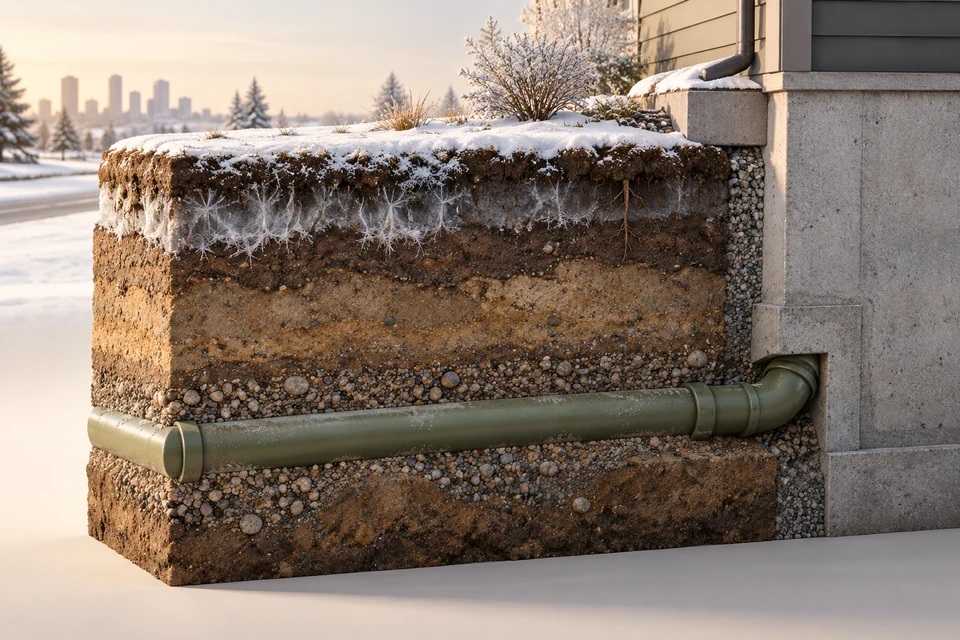
A residential sewer line's depth is set by three things: the cover needed to keep it from freezing, the depth where the building drain leaves the basement, and the depth of the municipal connection it must fall to. Calgary states 4.5 ft (about 1.37 m) of earth cover over sanitary services. Most Calgary-area house sewers end up well below that at the house end, because they leave under a basement.
- There is no single standard depth; cover, basement depth and connection depth decide it for each lot.
- Calgary states 4.5 ft of cover for sanitary sewer services and 8.5 ft for water services.
- The national plumbing code requires protection from freezing but leaves the depth to local rules.
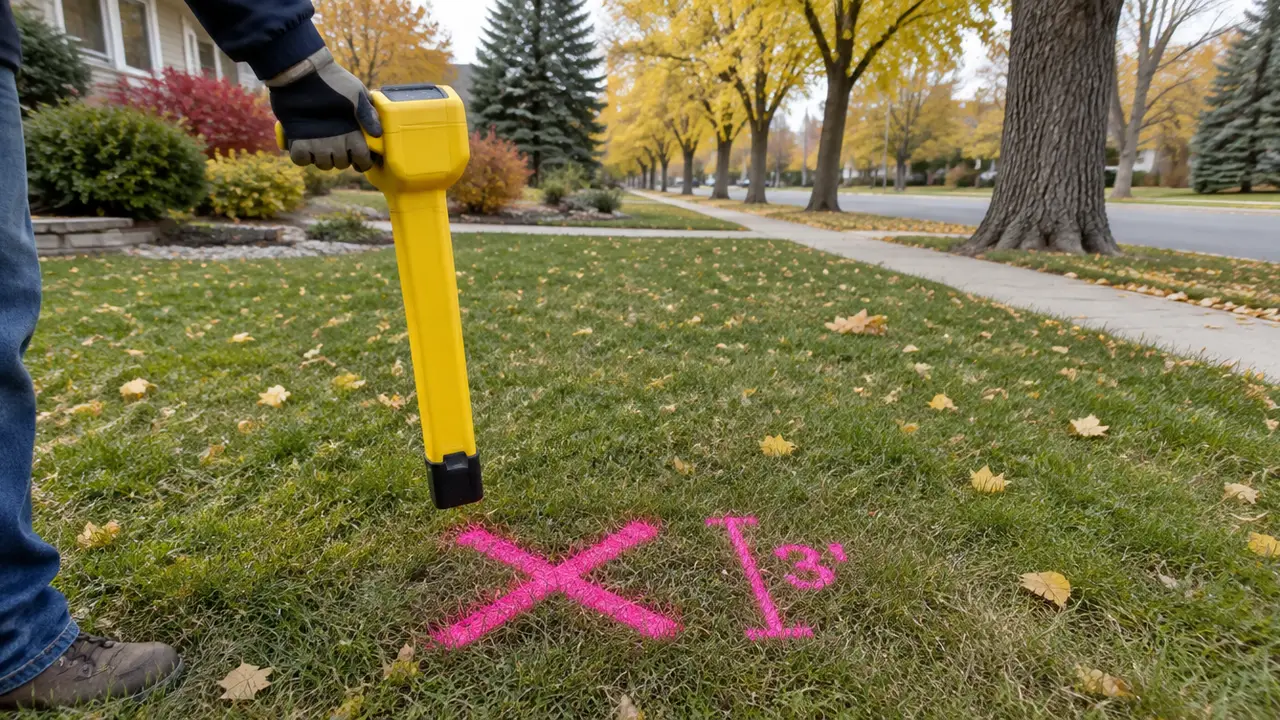
- You can find your own line's depth at the cleanout, from a sonde locate, or from municipal service records.
01 /What decides how deep a sewer line is?
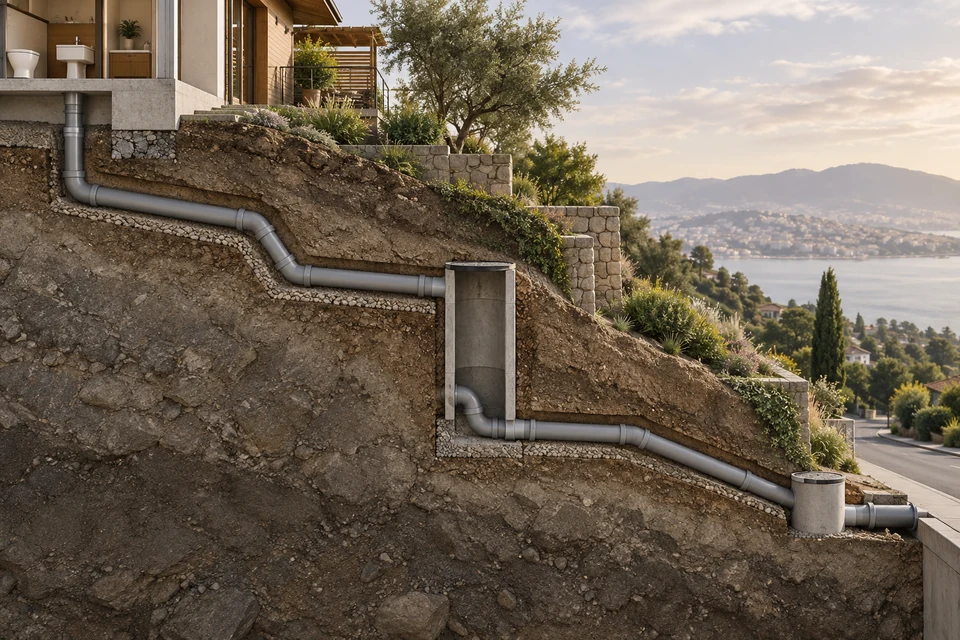
Three constraints, and the deepest one wins. The first is frost: the pipe must sit far enough below the surface that wastewater in it never freezes. The second is the house: a building drain that runs under a basement floor leaves the foundation well below grade, and the sewer starts where the drain leaves. The third is the connection: the pipe must fall at no less than the code minimum slope to the municipal service or main, whose depth is fixed. The installed depth along the run is whatever satisfies all three.
That is why people searching for an average sewer line depth get frustrating answers. On a bungalow with a shallow basement and a deep street main, the sewer may start deep and stay deep. On a house with a walkout basement or a slab-on-grade garage suite, the frost rule governs. The useful question is not the average but the local minimum cover, and whether your particular run meets it along its whole length.
| Constraint | What sets it | Where to get the number |
|---|---|---|
| Frost cover | Climate, soil and the municipality's rule | The permit issuer; Calgary publishes 4.5 ft for sanitary services |
| House end | Basement floor level and where the drain exits | Measure at the cleanout or from plans |
| Connection | The municipal service or main invert | Municipal service records or by exposing it |
| Slope between | Minimum 1 in 100 for a 4-inch sewer (NPC 2020) | The slope calculator |
02 /How deep does a sewer line have to be in Calgary?
Calgary's plumbing page for infill construction says trench depth and earth cover must comply with the City's frost protection requirement of 4.5 ft for sanitary sewer services and 8.5 ft for water services. In metric that is about 1.37 m and 2.59 m. Cover means soil above the top of the pipe, so the trench itself goes deeper by the pipe diameter and the bedding beneath it: at least 4 inches (100 mm) of bedding under the pipe, by the same City page.
The water service is much deeper because a water line is full and still between uses, so it freezes more readily than a sewer that is empty most of the time. When both services share a trench, which is common on infill lots, the water line sets the trench depth. Confirm the requirement for your own permit by calling 311, because the page is written for infill construction and a replacement or repair may be treated differently.
03 /What about Edmonton and the rest of Alberta?
Outside Calgary the picture is local. The National Plumbing Code of Canada 2020, in force across Alberta, says in Article 2.3.5.3 that piping which may be exposed to freezing must be protected from it, and says nothing about depth. So each municipality or the agency that issues permits for it sets or applies its own requirement.
Edmonton's drainage design standard, maintained with EPCOR, gives a useful reference point for new servicing: section 3.4.3 of Volume 3-03 (May 2025) sets new sanitary service connections with the invert 2.75 m below finished grade at the property line, and asks for at least 2.0 m of cover over storm and foundation drain services there, or insulated pipe where that cannot be achieved. That is a design standard for new services, not a rule for every private line, but it shows how much deeper northern Alberta servicing sits. For any other community, find the permit issuer through the Safety Codes Council and ask directly; the Sewer Depth & Frost Cover Planner lists the questions.
04 /Why do sewers freeze even when they are deep enough?
Usually because the cover was right in one place and wrong in another. The most common pattern is a line that meets the rule under a snow-covered lawn but rises, or loses soil above it, where it passes under a driveway or walkway that is shovelled bare all winter. Bare paving lets frost drive deeper than it does under snow. Other causes are a low spot that holds water (a belly), a slow drip from a fixture that keeps a trickle freezing in the pipe, and a section left shallow at the foundation where the drain exits.
Designing against this is simple in principle: check the cover along the whole route, not just at the ends, and add depth where the line runs under surfaces kept clear of snow. Where full cover is impossible, ask the permit office what it accepts; an approved insulation detail is its decision, not the installer's.
05 /How can you find out how deep your own sewer line is?
Four methods, from cheapest to most certain. None of them needs digging.
- Measure at the cleanout
With the cap off an exterior cleanout, a tape or rod dropped to the pipe bottom gives the invert depth at that point. An interior cleanout gives the drain height relative to the basement floor.
- Ask for a sonde locate
During a camera scope, the operator parks the camera and finds the sonde from the surface with a receiver that estimates depth. That gives depth at any point along the line.
- Check municipal records
Many municipalities keep service connection records showing the connection location and invert. In Calgary, start with 311.
- Look at the original permit drawings
Newer houses may have grading or servicing plans showing service inverts at the property line.
Sonde depth readings are estimates and can be thrown off by nearby metal and other signals, so treat them as approximate until the pipe is exposed. Before anyone digs to confirm a depth, utility locates are required; see the installation process.
06 /How deep is the sewer under a basement slab?
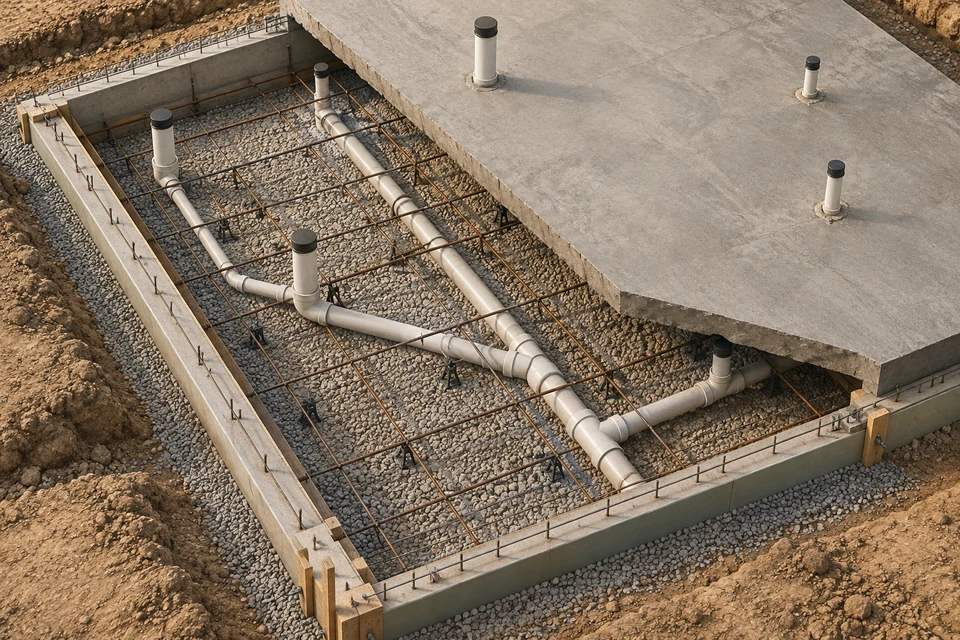
Under a basement, the building drain runs below the floor slab and then out under or through the foundation to become the building sewer. Its depth below the slab is set by the fixtures it serves and the slope it needs, so it is usually shallow relative to the floor but deep relative to the yard. That is why a house with a full basement often has a sewer starting two metres or more below outside grade, comfortably below Calgary's 4.5 ft cover, and why the frost rule mostly matters farther out, where the ground falls or the surface changes.
Adding a bathroom in that basement raises the opposite question: whether the new fixtures sit above the existing drain at all. If they do not, they need a pump. See basement bathrooms below the sewer and sewer lines under a slab.
07 /How does depth change the job and the price?
Depth changes nearly everything. A trench deeper than 1.5 m needs its walls cut back or supported before anyone enters under Alberta's OHS Code, and one deeper than 3 m needs an engineer-certified protective structure. Deep trenches need bigger machines, more spoil space, more backfill and more compaction, and they take longer. Sister-site ranges reflect it: new-service pipe work typically quotes $600 to $1,000 per metre when shallow and $1,000 to $2,000 per metre when deep or under hard surfaces, as 2026 planning estimates.
The honest trade-off is that depth is rarely optional. The cover rule and the connection depth are fixed, so the design choices are about route and surface, not about going shallower to save money. The installation cost guide shows how depth feeds into a quote, and if you want a second look at a design, send the details.
FAQQuestions people ask
How deep is a typical residential sewer line?
There is no single typical depth. In the Calgary region the rule is at least 4.5 ft of cover over a sanitary service, and lines leaving basements usually start deeper than that.
How deep is the city sewer main?
It varies street by street. Ask the municipality for the service connection record and invert for your lot rather than assuming.
Can a sewer line be too deep?
Not for the pipe itself, provided it is bedded and the pipe is rated for the load. Depth mainly adds trench safety work and cost.
How deep is the sewer at a cleanout?
Drop a tape to the pipe bottom through an exterior cleanout. That gives the invert depth at that spot.
Does a sewer line need to be below the frost line?
It must be protected from freezing. In practice that means meeting the local minimum cover, which Calgary states as 4.5 ft for sanitary services.
NETWORKGo deeper across the HAUSE Sewer network
Sewer line locating and depth: how the mark on your lawn is made
How sewer line locating and depth readings work: the sonde, the hand-held locator, peak and null readings, marking, accuracy, and calling before you dig.
Sewer line replacement cost by city: why local quotes differ
Sewer line replacement cost by city: why Calgary, Edmonton, Regina and other Canadian markets quote differently, GST/HST by province, and local drivers.
Hydro jetting weeping tile: how foundation drains are cleaned, and when they cannot be
Hydro jetting weeping tile explained: how foundation drains clog with silt, roots and iron ochre, how they are jetted from the sump, and when to replace them.