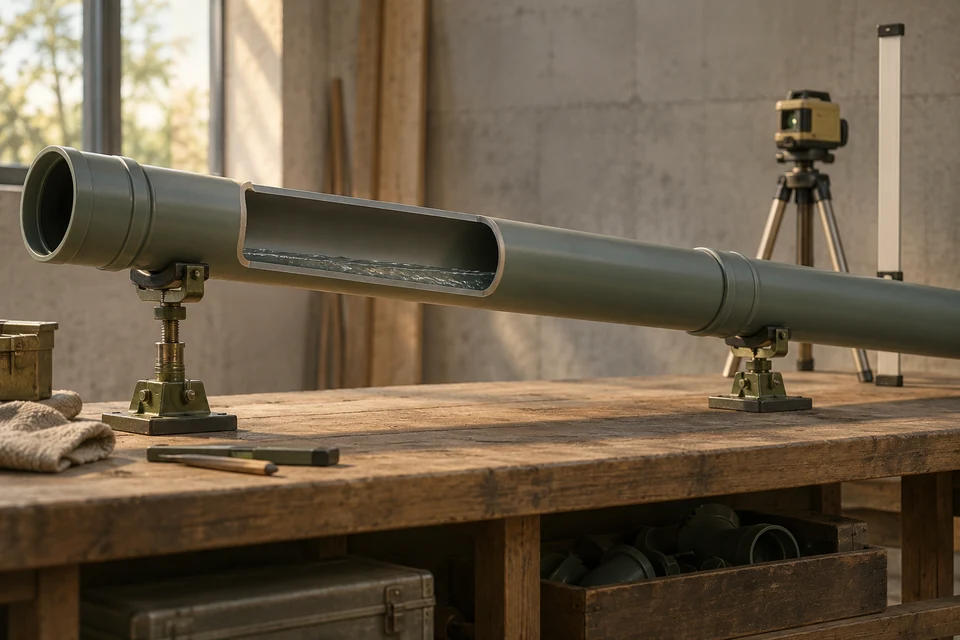
This glossary defines the words that appear in sewer installation quotes, permits and inspections in Canada, from invert and fall to haunching, fixture units and pre-backfill inspection. Definitions follow the National Plumbing Code of Canada 2020 where it uses the term, and plain trade usage otherwise, with Calgary and Alberta context where it matters.
- Building drain and building sewer are different parts of the same pipe: inside versus outside the building.
- Slope, grade and fall describe the same thing from different angles; the code works in ratios such as 1 in 100.
- Cover is soil above the top of the pipe; invert is the inside bottom of the pipe.
- A fixture unit is the code's measure of drainage load, used to size pipes.
01 /How should you use this glossary?
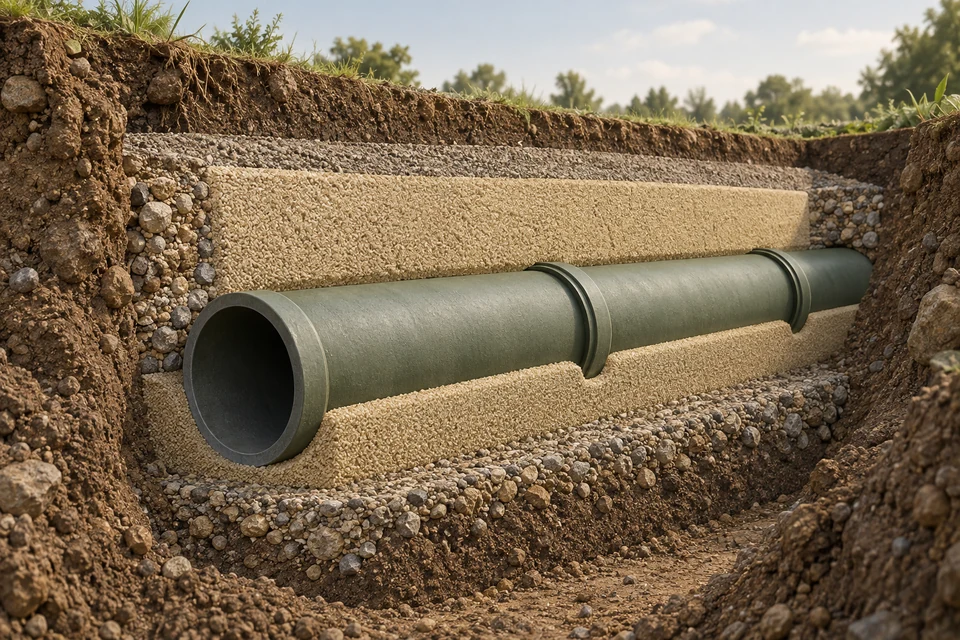
Keep it open while reading a quote, a permit drawing or an inspection note. Where a term has a code meaning, the definition follows the National Plumbing Code of Canada 2020, which Alberta enforces. Where it is trade language, the definition says so. Several terms have their own guides, linked below, and the figure shows many of them in one trench section.
Related guides: sewer pipe slope, bedding and backfill, materials and joints, cleanout installation and inspection and testing.
A–ZTerms
- ABS
- Acrylonitrile-butadiene-styrene, the black plastic drain pipe joined by solvent welding. Underground ABS drain pipe meets CSA B181.1 or ASTM F628 (cellular core).
- Air pressure test
- A test in which a plugged section of drainage pipe is pressurised to 35 kPa and must hold for at least 15 minutes without a drop, following the pipe maker's instructions (NPC 2.3.6.5).
- The body on whose behalf accredited agencies issue permits and inspect in municipalities that are not accredited to administer the Safety Codes Act themselves.
- As-built
- A drawing or record of what was actually installed, including route, depths and cleanout locations. Worth keeping with the permit.
- Backfill
- Material placed back in the trench after the pipe is laid and inspected. The code requires 300 mm of compacted, stone-free backfill over underground pipe unless the maker's instructions or concrete protection apply.
- Backwater valve
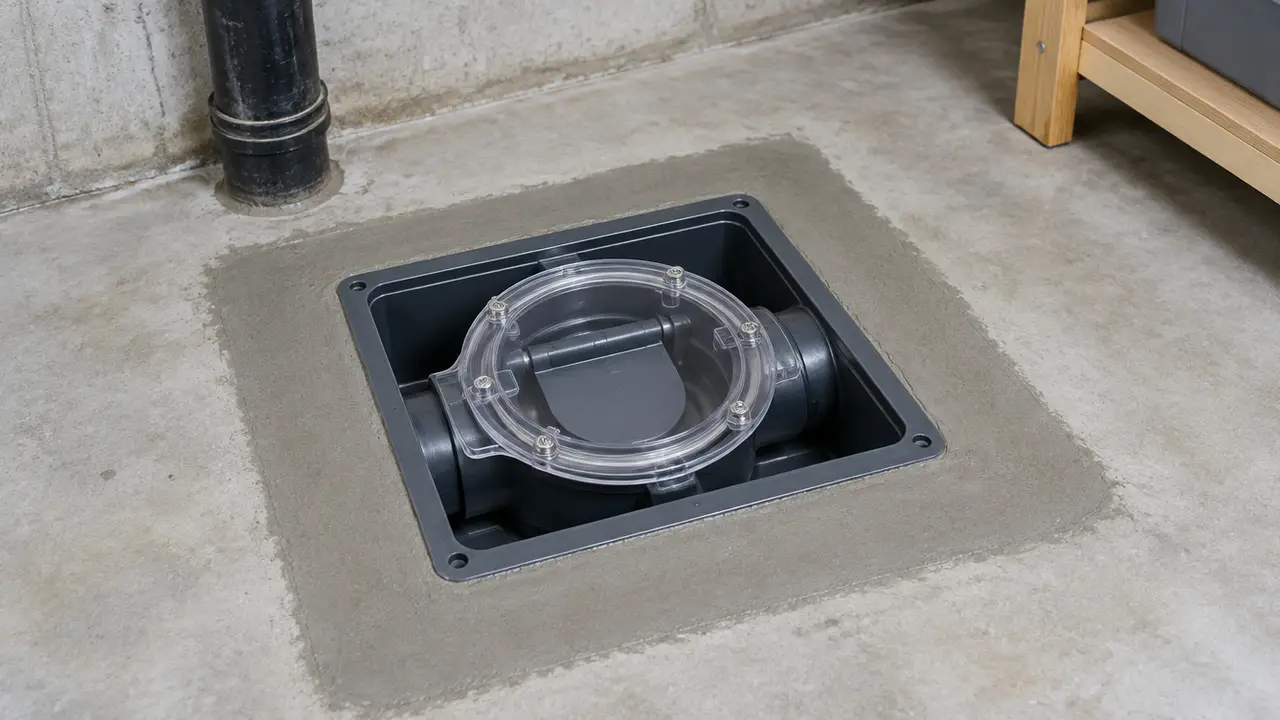
- A valve that lets flow leave the building and closes against sewage flowing back. Required where a drain may be subject to backflow for fixtures below the adjoining street (NPC 2.4.6.4).
- Ball test
- A test in which a hard ball dense enough not to float is rolled through a pipe to prove it is clear and continuous. Made when requested (NPC 2.3.6.7).
- Bathroom group
- A toilet, a basin and a bathtub or shower counted together for drainage load. With a tank toilet it counts as 6 fixture units.
- Bedding
- The material placed under and shaped around the lower part of a pipe so it bears evenly along its length. Calgary specifies at least 100 mm under the pipe of hard, durable particles no larger than 20 mm.
- Bell
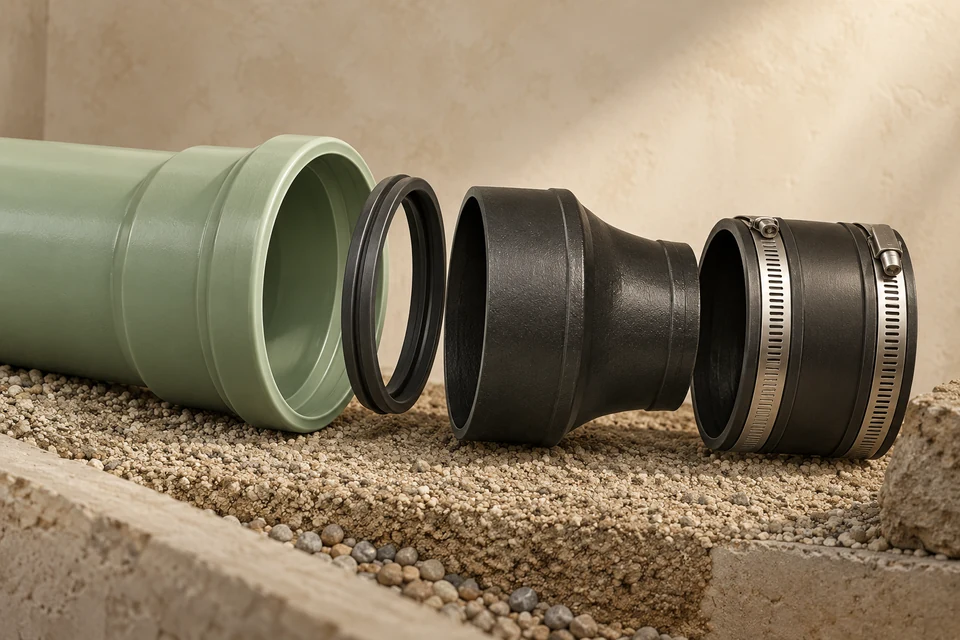
- The enlarged end of a pipe length that receives the spigot of the next. Laid facing upstream.
- Bell hole
- A small hollow scraped in the bedding under each bell or coupling so the pipe barrel, not the joint, bears on the bed.
- Belly
- A sag in a laid pipe that holds water and solids. Usually caused by poor bedding or settlement; fixed by relaying the section.
- Building drain
- The lowest horizontal piping inside a building that collects drainage and carries it to the building sewer. Needs an NPS 4 cleanout near where it leaves the building.
- Building sewer
- The pipe that carries drainage from the building drain, outside the building, to a public sewer or other point of disposal. At least NPS 4 where connected to a public sewer (NPC 2.4.9.4).
- Butt fusion
- Joining high-density polyethylene pipe by facing, heating and pressing the ends together until they fuse, leaving a bead on each side.
- Cleanout
- A capped opening that gives cleaning and inspection equipment access to a drain or sewer. Size and spacing are set by NPC 2.4.7.1 and Table 2.4.7.2.
- Compaction
- Densifying bedding or backfill with tampers, plates or rollers so it will not settle later. Done in lifts.
- Cover
- The depth of soil from finished grade to the top of a buried pipe. Calgary states 4.5 ft of cover for sanitary services and 8.5 ft for water services.
- CSA B182.2
- The Canadian standard for PSM type PVC sewer pipe and fittings, the usual gasketed green or cream sewer pipe. Underground use requires pipe stiffness of at least 320 kPa.
- CSA B602
- The Canadian standard for mechanical couplings on drain, waste, vent and sewer pipe, required for non-pressure couplings (NPC 2.2.10.4).
- Deflection
- A gradual change in direction along a pipe run. Calgary allows no more than 5 degrees every 3 m on services.
- Developed length
- The length of a pipe measured along its centreline, including fittings, rather than straight-line distance.
- Dewatering
- Pumping groundwater out of a trench so bedding can be placed and compacted in the dry.
- Fall
- The total vertical drop of a pipe over its run: run length multiplied by slope. A 15 m run at 1 in 100 falls 150 mm.
- Final test
- A smoke or air test on a completed drainage and venting system with traps filled, holding a 25 mm water column for 15 minutes, made when requested (NPC 2.3.6.6).
- Fixture unit
- The plumbing code's unit of drainage load. Each fixture has a value in Table 2.4.9.3, and pipe capacity at each slope is listed in fixture units.
- Frost protection
- Keeping buried pipe from freezing, usually by depth of cover. The NPC requires protection (2.3.5.3); municipalities set the depth.
- Gasket joint
- A bell-and-spigot joint sealed by a rubber ring in the bell, made by pushing the spigot straight in to its insertion mark.
- Grade
- Trade word for the slope of a pipe, and for setting that slope: "laying to grade".
- Haunching
- Bedding material worked in and compacted beside the lower half of a pipe so it is supported on its sides as well as underneath.
- HDPE
- High-density polyethylene pipe, heat-fused into continuous lengths. Used underground mainly for trenchless renewal, where the NPC requires ASTM F714, HDPE 3408, SDR 11 or heavier.
- Hydraulic load
- The drainage load on a pipe expressed in fixture units. Table 2.4.10.6.-C sets the maximum for each size and slope of a sanitary building drain or sewer.
- Initial backfill
- The clean material placed around and over the pipe after bedding, up to at least 300 mm above it, before native soil goes in.
- Insertion mark
- The line on a spigot that shows how far it must go into the bell for a proper gasket joint.
- Invert
- The inside bottom of a pipe. Slopes, depths and connections are designed to invert elevations.
- Laser level (pipe laser)
- An instrument set in the pipe that projects a beam at the design slope to a target in each new length, used to lay pipe to grade.
- Lateral
- Common term for the service pipe from a building to the municipal main, often used for the building sewer plus the municipal service.
- Lift
- One layer of backfill placed and compacted before the next.
- Locate
- Marking of buried utility lines on the ground before digging. In Alberta, requested through Utility Safety Partners with at least three full working days' notice.
- Macerating toilet system
- A toilet with a grinder pump that discharges through small pipe. Only permitted where no gravity connection is available (NPC 2.4.3.5).
- Main cleanout
- The cleanout of NPS 4 or larger as close as practical to where the building drain leaves the building (NPC 2.4.7.1(6)).
- Manhole
- An access structure on larger sewers. A required cleanout on a building sewer of NPS 8 or larger must be a manhole.
- National Plumbing Code of Canada (NPC)
- The model plumbing code published by the National Research Council. The 2020 edition has been in force across Alberta since April 1, 2023 with no Alberta variations.
- Normally open backwater valve
- A backwater valve whose flap rests open so air circulates, closing only on backflow. The type the code allows in a building drain serving one dwelling unit.
- NPS
- Nominal pipe size, the size designation used in the code: NPS 4 is the usual 4-inch building sewer.
- Orangeburg
- Bituminous fibre pipe used in some older sewers, prone to deforming and blistering. Found when replacing old laterals.
- Permit
- Authorisation from the municipality or accredited agency to do plumbing work. Calgary requires one to install, alter or add to a plumbing system.
- Pipe stiffness
- A measure of a flexible pipe's resistance to deflection under load. Plastic sewer pipe used underground must have at least 320 kPa under the NPC.
- Pre-backfill inspection
- The municipal inspection of a new sewer while the trench is open. Calgary generates sanitary and storm inspections at this stage.
- Property line
- The legal boundary of the lot, often where private and municipal responsibility for a sewer meet. Confirm the split locally.
- PVC
- Polyvinyl chloride pipe: white or grey drain pipe under CSA B181.2, or green and cream sewer pipe under the CSA B182 series.
- Quick trench
- A Calgary program for new single and semi-detached homes in which qualified contractors photograph each trench before backfill instead of waiting for a site inspection.
- Rodding
- Pushing a cleaning cable or rod through a drain. Cleanouts that rod one way must point in the direction of flow.
- Rough-in
- Drainage and vent piping installed and capped before walls or floors are closed, tested and inspected at that stage.
- Saddle hub
- A fitting clamped over a hole in a pipe to add a branch. Not permitted in drainage, venting or water systems (NPC 2.2.10.5).
- Shoring
- Temporary supports that hold trench walls. Required, or the walls cut back, where a trench is deeper than 1.5 m in Alberta.
- Slope
- The drop of a pipe per unit length, written as a ratio (1 in 100), percent (1%) or fall per metre (10 mm). Minimums are set by pipe size in the NPC.
- Solvent weld
- A joint in ABS or PVC made with primer where required and the solvent cement for that material, which fuses the socket and spigot.
- Spigot
- The plain end of a pipe length that goes into the bell of the next.
- Sump
- A basin that collects drainage too low to flow to the sewer by gravity. When it receives sewage it must be water- and air-tight and vented (NPC 2.4.6.3).
- Tie-in
- The connection of a new branch into an existing drain or sewer, made with a wye pointed downstream.
- Trench box
- A portable steel protective structure placed in a trench so workers can work inside it safely.
- Utility Safety Partners
- Alberta's one-call service for locate requests. Older paperwork may refer to Alberta One-Call.
- Water pressure test
- A test in which a plugged section is filled so there is a water column of at least 3 m on every joint, kept full for 15 minutes (NPC 2.3.6.4).
- Wye
- A Y-shaped fitting that brings a branch into a drain at an angle in the direction of flow. The standard way to join drainage branches.