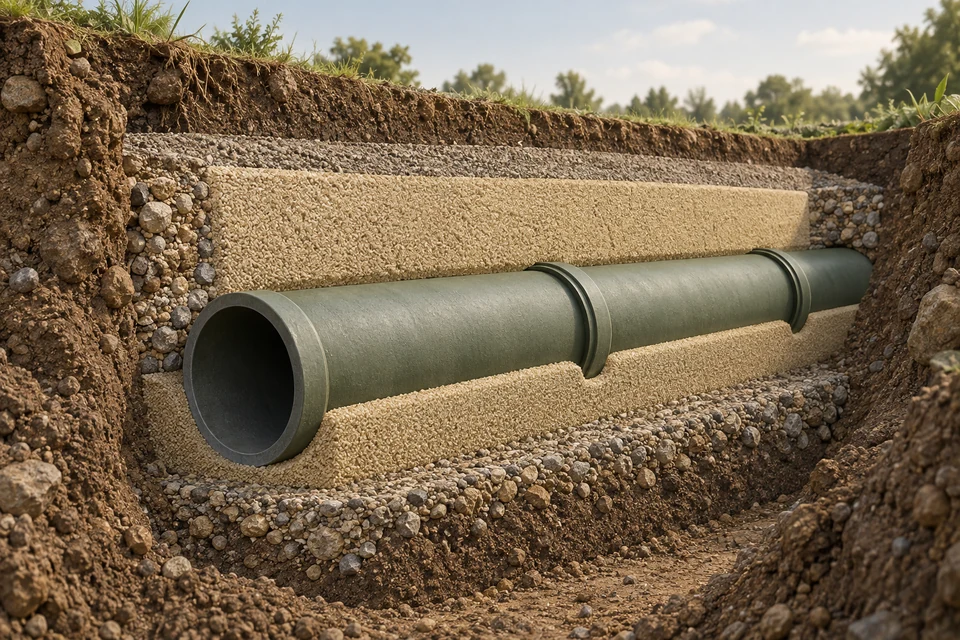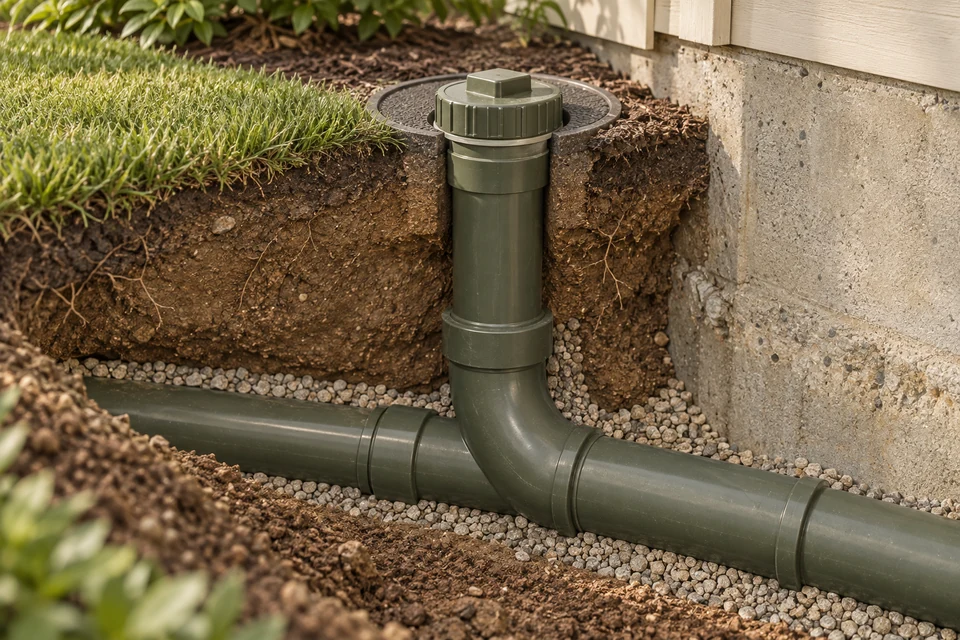
Every building drain needs a cleanout of at least NPS 4 as close as practical to where it leaves the building, under the National Plumbing Code of Canada 2020. Beyond that, 3 and 4-inch lines need cleanouts no more than 15 m apart when they rod one way, or 30 m when they rod both ways, plus cleanouts where bends exceed the allowance. Installing one typically quotes $600 to $2,500.
- Main cleanout: NPS 4 or larger, as close as practical to where the building drain leaves the building (NPC 2.4.7.1(6)).
- Spacing for NPS 3 and 4: 15 m one-way, 30 m two-way; over NPS 4: 26 m and 52 m (Table 2.4.7.2).
- A building sewer may not change slope or direction between cleanouts except within the bend allowance (2.4.7.1(5)).
- Cleanouts must be readily accessible and cannot double as a floor drain (2.4.7.4).
01 /What is a sewer cleanout for?
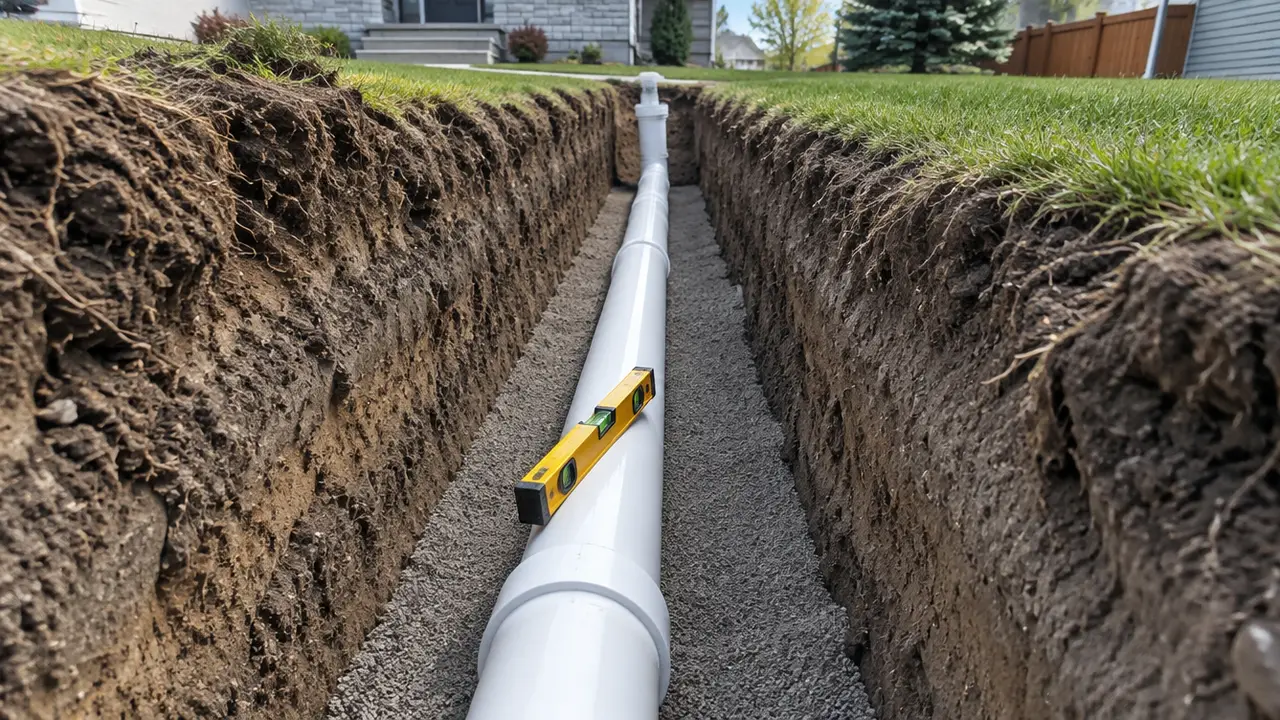
A cleanout is a capped opening in the drainage system that lets a cable, a jetter hose or a camera get into the pipe without taking anything apart. The code's starting principle, in Article 2.4.7.1(1), is that sanitary and storm drainage systems must have cleanouts that permit cleaning of the entire system. Everything else about placement follows from that: an opening near the building so the sewer can be reached from its start, openings spaced close enough that equipment can reach between them, and openings where the pipe turns so a cable does not have to force its way around a corner.
For the owner, a good cleanout layout is the difference between a routine clearing and a toilet pulled off the floor, or a camera inspection that stops short of the city connection. For the installer, cleanouts are part of the design, drawn on the permit plan and checked by the inspector.
02 /Where must the main cleanout go?
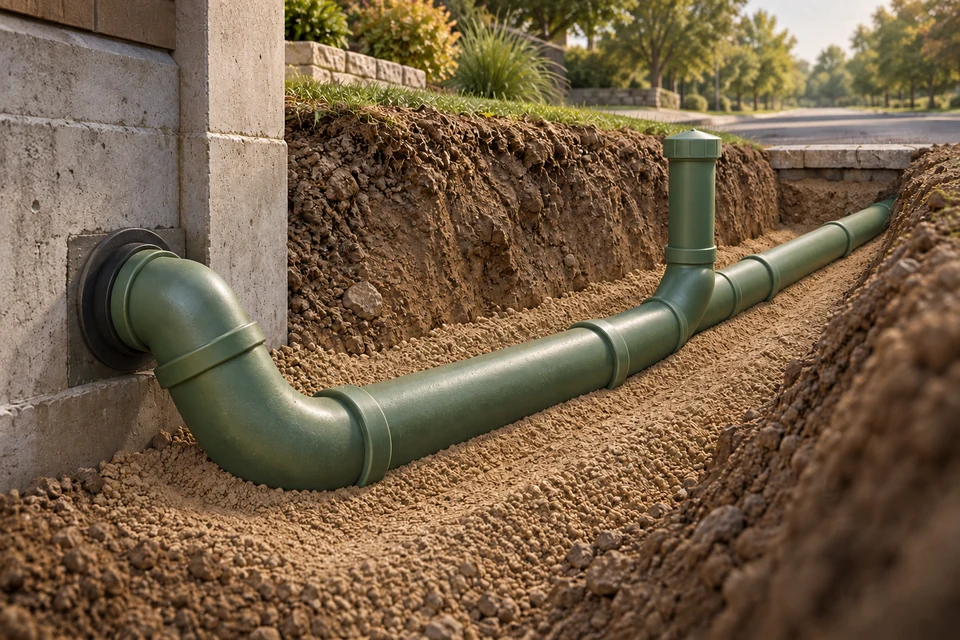
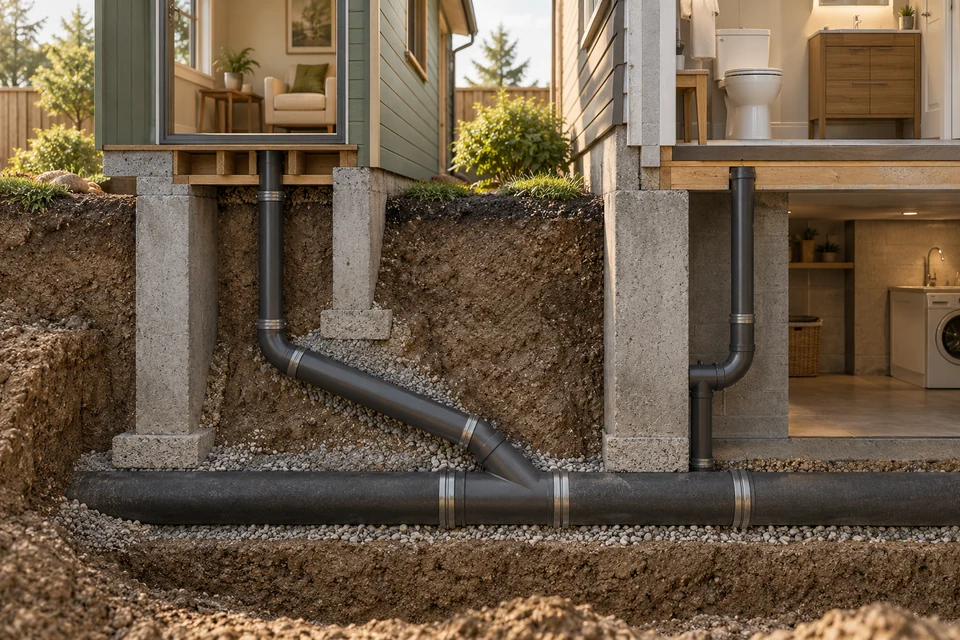
Close to where the building drain leaves the building. Sentence 2.4.7.1(6) requires building drains to have a cleanout fitting of NPS 4 or larger located as close as practical to that point. The code's explanatory note explains why: to suit the limits of sewer cleaning equipment, the cleanout should be as close as possible to the exterior wall, inside or outside, and accessible for that equipment. In a basement it is often a wye with a capped branch just inside the foundation; outside, it is a riser to a cap at or near grade.
Other cleanout requirements in the same article cover the rest of the drainage system: at or near the bottom of each stack (within 3 m upstream, or on the wye joining the stack to the drain), downstream of an interceptor, over running traps, and an extra cleanout on a building drain for each cumulative horizontal change of direction exceeding 135 degrees. Where a building sewer is NPS 8 or larger, a required cleanout must be a manhole.
03 /How far apart can cleanouts be?
It depends on pipe size and on whether a cleanout lets equipment in one direction or both. Table 2.4.7.2 of the code sets the limits for nominally horizontal pipe.
| Drainage pipe size | Minimum cleanout size | Maximum spacing, one-way rodding | Maximum spacing, two-way rodding |
|---|---|---|---|
| Less than NPS 3 | Same as the pipe | 7.5 m | 15 m |
| NPS 3 and 4 | NPS 3 | 15 m | 30 m |
| Over NPS 4 | NPS 4 | 26 m | 52 m |
A cleanout that allows rodding in one direction only must be installed so rodding goes in the direction of flow (Sentence 2.4.7.2(5)). The main cleanout at the building is covered by its own rule, NPS 4 or larger, which is why a 4-inch sewer's first cleanout is 4-inch even though the table would allow 3-inch elsewhere. On a long private line, for example to a detached suite at the back of a deep lot, the spacing rule often adds a cleanout partway.
04 /When does a bend or slope change need a cleanout?
Whenever it goes beyond the allowance. Sentence 2.4.7.1(5) says a building sewer shall not change direction or slope between the building and the public sewer or between cleanouts, except that pipes of NPS 6 or less may change direction by no more than 5 degrees every 3 m, or by fittings with a cumulative change in direction of no more than 45 degrees. Any change of slope, and any change of direction beyond that, therefore happens at a cleanout.
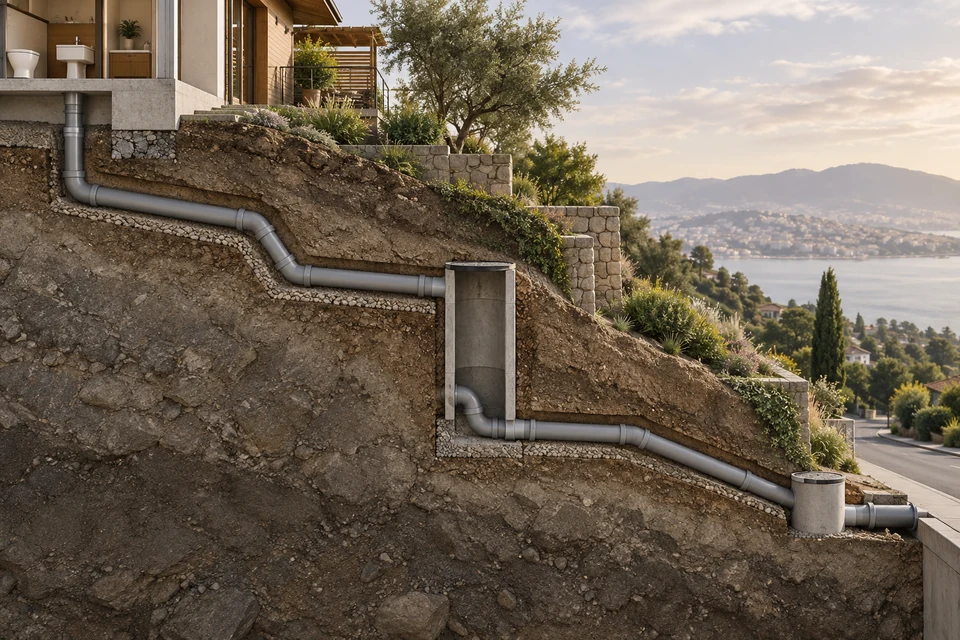
On an irregular lot, the route is often drawn to use the 45-degree allowance once and keep everything else straight. When a second turn is unavoidable, the cleanout goes at the turn. The same logic applies to steep lots, where each change of grade gets a cleanout; see sewer lines on steep lots.
05 /Inside or outside: which cleanout is better?
Both work if they are accessible, and many houses have both. The code requires cleanout openings to be readily accessible for drain cleaning, not placed in a floor in a way that creates a hazard, and not used as a floor drain (Article 2.4.7.4). It also limits the piping between a cleanout fitting and the system it serves to a change of direction of no more than 45 degrees, so equipment enters in line with the pipe.
06 /Can a cleanout be added to an existing sewer?
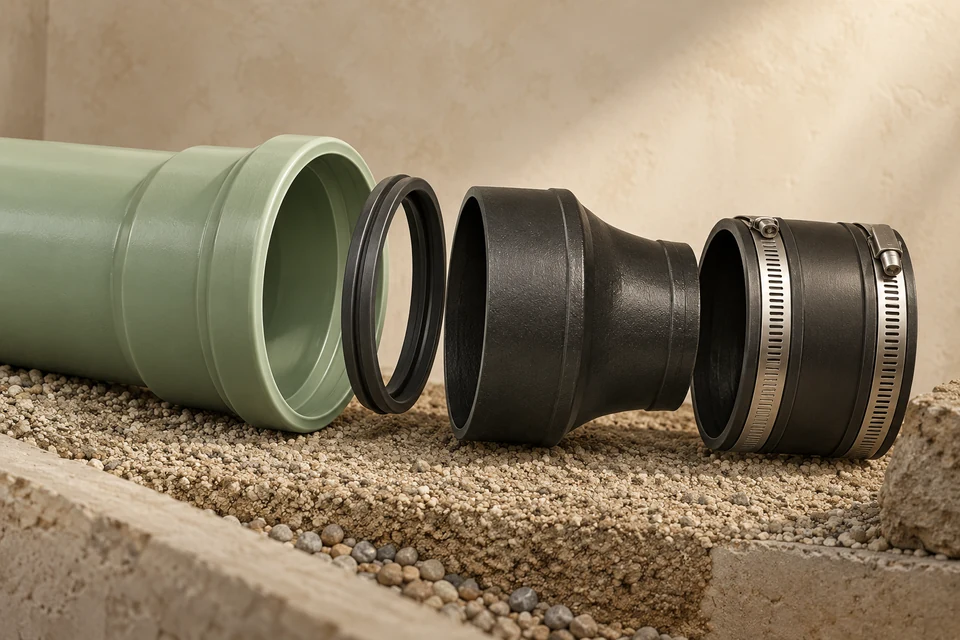
Yes, and it is one of the most useful small projects on an older house with no accessible cleanout. An exterior retrofit means locating the sewer, excavating to it, cutting in a wye with a riser to grade, and backfilling; an interior retrofit means breaking out the basement floor at the drain and cutting in a cleanout fitting. Either needs a plumbing permit and an inspection in Calgary, because it alters the drainage system. The fitting must be one that can withstand being removed and reinstalled and seal gas-tight (NPC 2.2.10.3).
A cleanout also makes trenchless options possible. Lining or inspecting a lateral from an outside cleanout, rather than through the house, is common where one exists; the repair side of that is covered by sister site TrenchlessSewerRepair.ca. Ask for the retrofit to be sized at NPS 4 where the main cleanout rule applies.
07 /What does installing a sewer cleanout cost?
As a 2026 planning estimate, installing a sewer cleanout typically quotes $600 to $2,500 CAD, the range published on sister sites SewerQuotes.com and SewerReplacement.ca. On a new sewer, the cleanout is part of the pipe work and sits toward the low end. A retrofit sits higher, because it needs locating, excavation or slab work, a permit and restoration.
| Situation | Where in the range | Why |
|---|---|---|
| Included in a new sewer installation | Low | Trench already open, one more fitting and riser |
| Exterior retrofit under lawn, shallow | Middle | Locate, small excavation, cut in, backfill |
| Exterior retrofit, deep or under paving | High | Deeper dig, shoring, concrete or asphalt repair |
| Interior retrofit through a finished floor | High | Saw-cut slab, finishes removed and replaced |
More line items are in the installation cost guide. To get a cleanout added or a layout checked, send the details.
FAQQuestions people ask
Does every house need a sewer cleanout?
The code requires a cleanout of at least NPS 4 near where the building drain leaves the building. Older houses built before modern rules may lack an accessible one.
How much does it cost to install a sewer cleanout?
Typically $600 to $2,500 CAD as a 2026 planning estimate, lower when included in new work and higher for deep or interior retrofits.
Can a cleanout be used as a floor drain?
No. NPC 2020 Article 2.4.7.4 says a cleanout shall not be used as a floor drain.
How many cleanouts does a 30 m sewer need?
For 4-inch pipe, the main cleanout at the building plus enough to keep spacing within 15 m one-way or 30 m two-way, and more at any bends beyond the allowance.
Does adding a cleanout need a permit in Calgary?
Yes. It alters the plumbing system, and Calgary requires a permit to install, alter or add to a plumbing system.
NETWORKGo deeper across the HAUSE Sewer network
Sewer inspection points and cleanouts: how to find, use or move one
What a sewer inspection point, chamber or cleanout is, how to find yours in a Canadian house, whether you can move or add one, and scoping through a toilet.
Where is my backwater valve? How to find it, recognize it and open the cover
Where is the backwater valve in a house? How to find it, what it looks like, what access box, sleeve and cover mean, how to open it safely, and valve alarms.
Backwater valve installation cost and municipal subsidies
Backwater valve installation cost in Canada for 2026: CAD ranges for unfinished and finished basements, line items, subsidy program patterns and insurance angles.