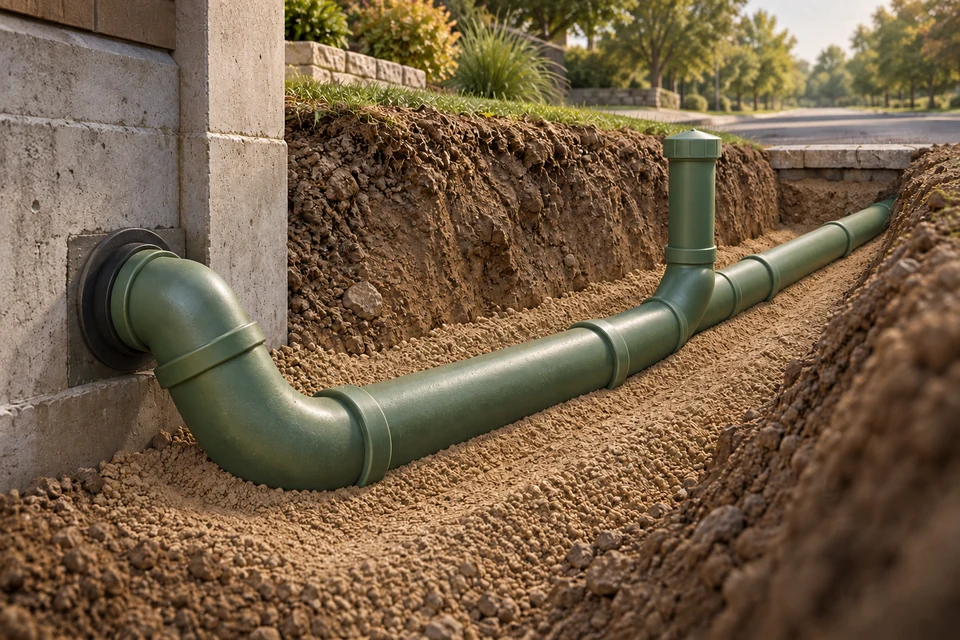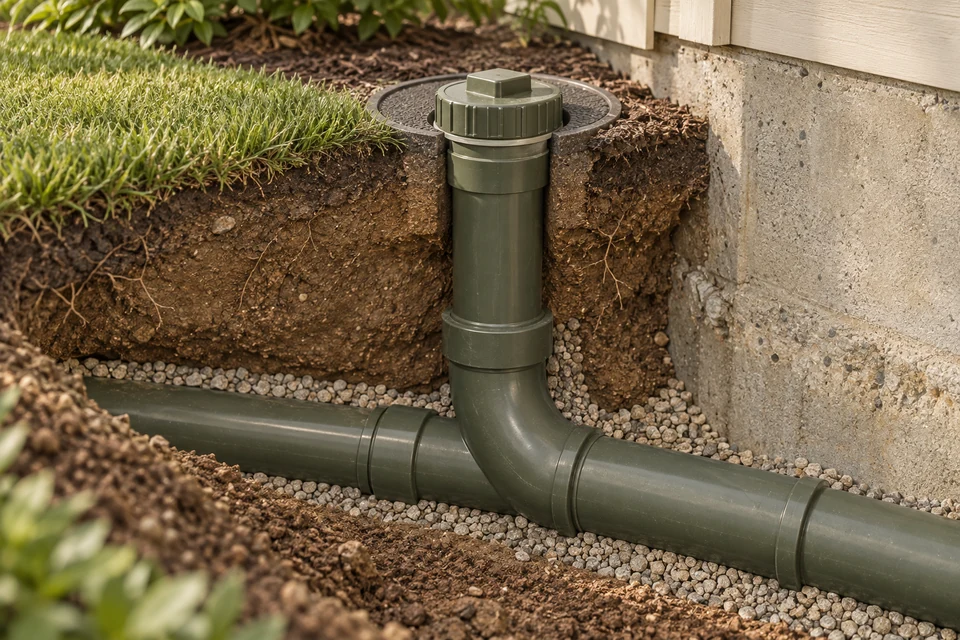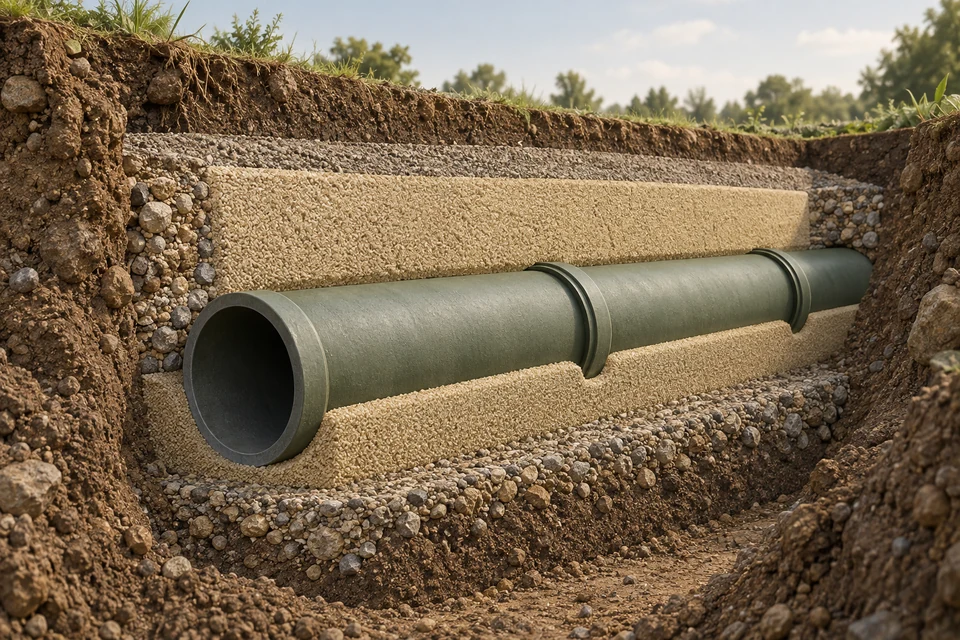
Sewer pipe must rest on a firm, continuous base under its whole length and be protected by at least 300 mm of compacted, stone-free backfill over the top, under the National Plumbing Code of Canada. Calgary specifies at least 100 mm of hard, durable bedding no larger than 20 mm under the pipe and 300 mm over and to each side, with native soil compacted in lifts above.
- The code requires a firm, continuous base under the whole pipe; blocks, bricks or a boulder under the pipe are not permitted.
- Over the pipe: 300 mm of compacted backfill free of stones, cinders and frozen earth, or 75 mm of concrete at least 200 mm wider than the pipe.
- Calgary: at least 4 in (100 mm) of bedding under, 12 in (300 mm) over and to each side, particles no larger than 0.75 in (20 mm).
- Most bellies and sunken trench lines trace back to soft spots, missing haunch support or skipped compaction.
01 /Why does bedding matter so much for a sewer?
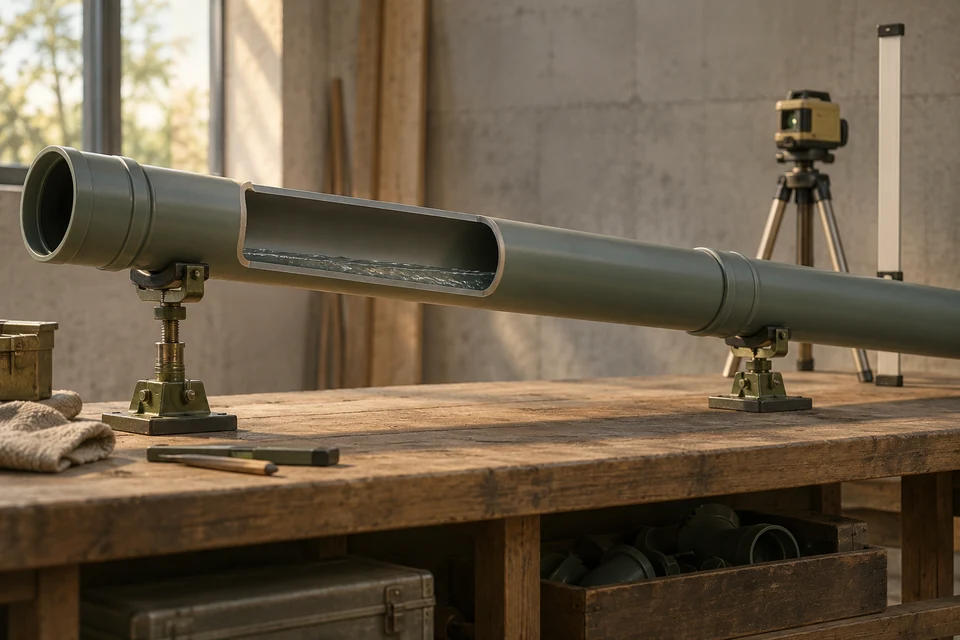
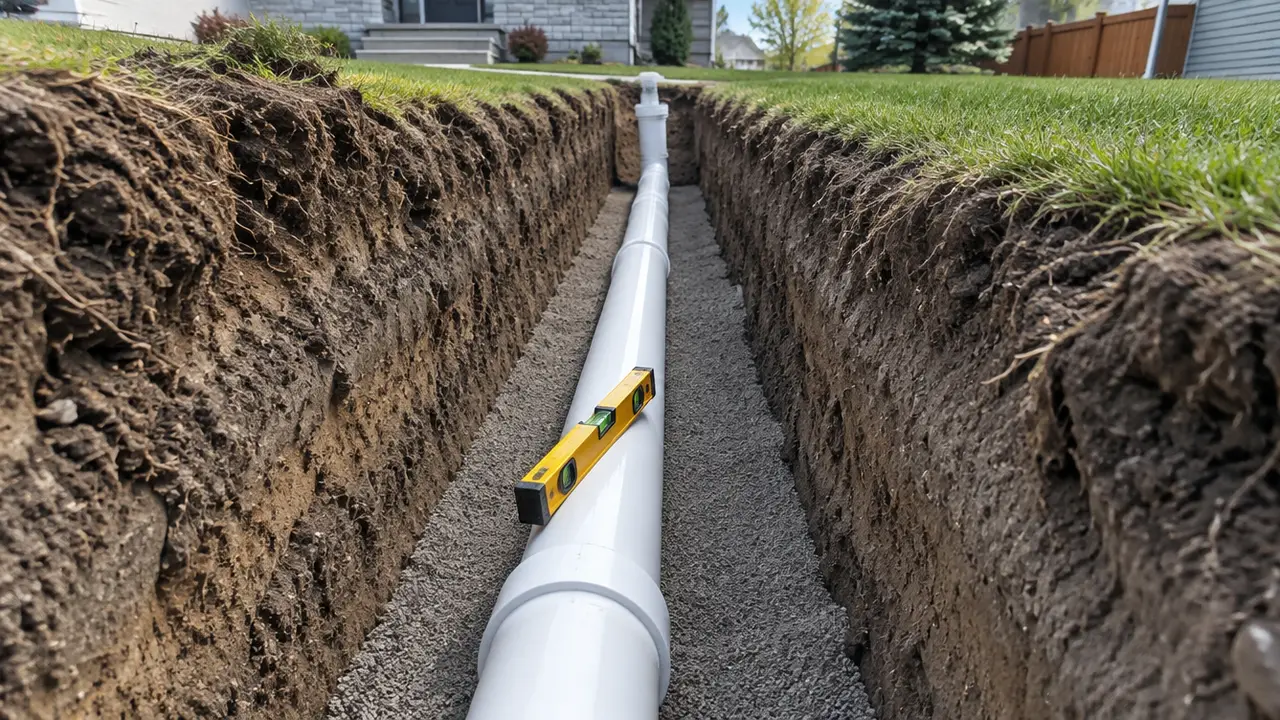
Because a gravity sewer is only as straight as the ground under it. The pipe is laid to a precise grade on the day, but it has to hold that grade for decades while soil settles, frost comes and goes and loads pass overhead. If the base is soft in one place, the pipe sinks there and a belly forms. If it rests on a stone, the load concentrates at one point and the pipe can crack or deflect. If the sides are loose, flexible plastic pipe can squash out of round under the weight of fill. Bedding and backfill are what keep the installed grade installed.
Plastic sewer pipe, the usual choice for new lines, is designed to work with the soil around it: the compacted material at its sides helps it carry the load from above. That is why the haunches, the zone beside the lower half of the pipe, get so much attention from careful installers. A pipe with a perfect bed underneath and loose material at its sides is only half supported.
02 /What does the plumbing code require?
Two articles in the National Plumbing Code of Canada 2020, which Alberta enforces without changes, set the baseline. Article 2.3.4.6 says nominally horizontal piping that is underground shall be supported on a base that is firm and continuous under the whole of the pipe. Its explanatory note shows what is not permitted: pipe resting on blocks, or on a boulder, because such a base does not give firm, continuous support. The only alternative the article allows is hangers fixed to a foundation or structural slab that can keep the pipe aligned and carry the pipe, its contents and the fill over it.
Article 2.3.5.1 protects the pipe from above. In the absence of the pipe maker's backfill instructions, underground piping is protected by backfill placed and compacted to a height of 300 mm over the top of the pipe and free of stones, boulders, cinders, frozen earth or other damaging material, or by concrete at least 75 mm thick and at least 200 mm wider than the pipe. The note to that article adds two practical points: stronger pipe may be required in deep fill or under driveways and parking areas, where compaction for the full depth of the trench may be necessary, and the lower part of the trench should be as narrow as proper jointing and backfill allow.
03 /What does Calgary specify for bedding?
Calgary's plumbing page for infill construction sets out the City's bedding requirement for services in plain numbers, and it is a sound specification to ask for anywhere in the region.
| Item | Requirement |
|---|---|
| Material | Hard, durable particles free from clay lumps, cementation, organic material, frozen material and anything that may cause harm or damage |
| Particle size | No larger than 0.75 in (20 mm) |
| Under the pipe | At least 4 in (100 mm) |
| Over the pipe | 12 in (300 mm) |
| Each side | 12 in (300 mm) |
| Proof | Quick trench installations must photograph every trench before backfill, showing pipe size and material, backfill material and location |
The City does not name a product, and the right material is whatever meets the description and the pipe maker's instructions. Ask your installer what they will use and why. Other municipalities around Calgary may have their own wording; Cochrane's homeowner guide, for example, simply requires groundworks to be bedded, supported and protected. The local detail is on the service areas page.
04 /What are the zones of a sewer trench?
Installers think of the trench in layers from the bottom up, each with its own job.
- Trench bottom
Dug to grade minus the bedding depth. Soft, wet or organic spots are removed and replaced with compacted granular fill.
- Bedding
At least 100 mm in Calgary, compacted and graded to the line, with bell holes so joints do not carry the pipe.
- Haunching
Material worked in beside the lower half of the pipe and compacted so the pipe is supported on its sides.
- Initial backfill
Clean material brought up to at least 300 mm over the pipe, compacted with light equipment or by hand.
- Final backfill
Native soil, free of rocks and frozen lumps, placed in lifts and compacted one lift at a time.
- Surface
Topsoil and sod or seed, or the base and finish for concrete, asphalt or pavers.
The lift thickness and compaction method depend on the soil and the equipment; the point is that each layer is compacted before the next goes on. Dumping the whole trench full and running a machine over the top compacts the surface and leaves the depth loose, which is how a trench line sinks into the lawn the following spring.
05 /What goes wrong when bedding is skipped?
The failures are predictable, and most show up on a camera long before they cause a backup.
| What you see | Usual cause | Fix |
|---|---|---|
| Belly or sag holding water | Soft spot in the trench bottom, over-dig filled with loose soil, or settlement | Dig up and relay that section on a proper bed |
| Pipe out of round | Loose haunches, heavy compaction too close to the pipe, or rocks against it | Replace the deformed section |
| Crack or broken bell | Pipe resting on a stone or on its joints | Replace the section with bell holes and a continuous bed |
| Sunken trench line at the surface | Final backfill not compacted in lifts | Top up and recompact; check the pipe on camera |
| Offset joint | Differential settlement between a firm and a soft section | Relay with a uniform base |
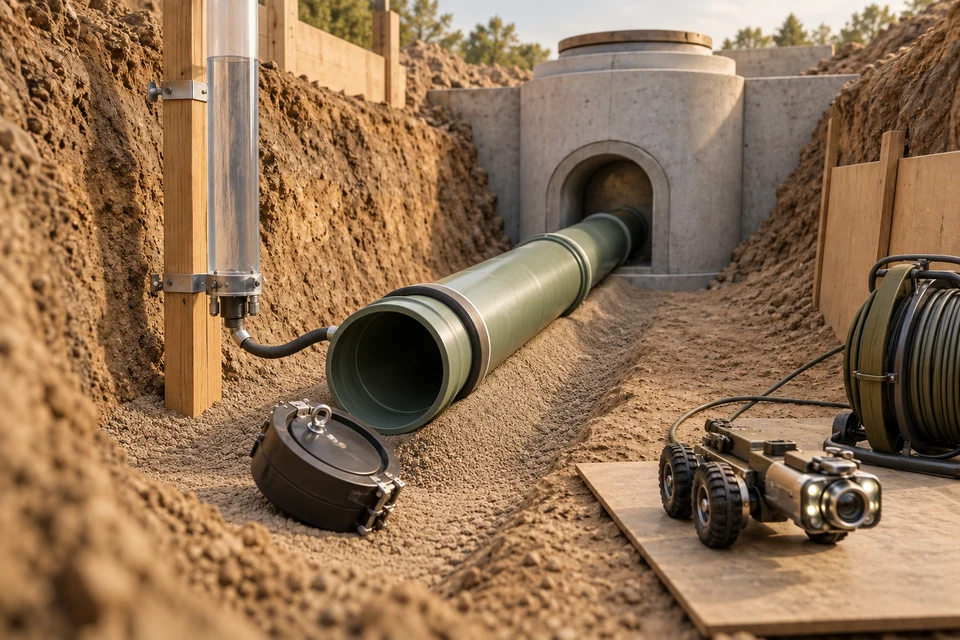
Because these defects are buried, the pre-backfill inspection and a camera run after laying are the only real chances to catch them. Inspection and testing explains what inspectors look at.
06 /Can frozen soil or wet ground be used as backfill?
Not around the pipe. The national code excludes frozen earth from the 300 mm of backfill over the pipe, and Calgary's bedding specification excludes frozen material outright. Frozen lumps do not compact, and when they thaw they leave voids that let the pipe and the surface settle. In winter installations, spoil is protected from freezing or replaced with thawed or imported material for the pipe zone.
Wet ground is a different problem. Groundwater in the trench floats fine material and makes compaction difficult; it is pumped out before bedding goes in, and in persistent water the installer may use a coarser, free-draining bedding or wrap it with a separating fabric to stop fines migrating into it. These are site decisions and should be written into the quote when the soil report or the first test pit suggests water.
07 /Does a sewer under a driveway need anything different?
Often, yes. The code's note on trench backfill says stronger pipe may be required in deep fill or under driveways and parking areas, and that compaction for the full depth of the trench may be necessary. Vehicle loads reach down into the soil, and a trench under a driveway that settles even slightly will crack concrete or dip asphalt. Ask whether the installer will compact the full trench depth under paved areas, and whether the pipe chosen is suited to the load and depth. Frost also reaches deeper under paving cleared of snow, which is a reason to check cover there; see how deep is a sewer line?.
08 /What should you ask your installer about bedding?
- What bedding material will you use, and does it meet the municipality's specification?
- How deep will it be under the pipe, and how far over and to the sides?
- Will you dig bell holes, and how will you support the haunches?
- How will you compact the backfill, and in what lift thickness?
- What will you do if the trench bottom is soft or wet?
- Will you photograph the bedded pipe before backfill, and can I have the photos?
An installer who answers those confidently has usually done it properly for years. For the full laying sequence, read how a sewer line is installed; for budgeting, the installation cost guide; and to have your project looked at, send the details.
FAQQuestions people ask
What is the best bedding for a sewer pipe?
Material that meets the local specification and the pipe maker's instructions. Calgary asks for hard, durable particles no larger than 20 mm, free of clay lumps, organics and frozen material.
How much bedding goes under a sewer pipe?
Calgary specifies at least 4 inches (100 mm) under the pipe, with 12 inches (300 mm) over it and to each side.
Can I backfill a sewer trench with the dirt I dug out?
Above the pipe zone, native soil free of rocks and frozen lumps is normally used, compacted in lifts. Around and just over the pipe, use the specified bedding material.
Can a sewer pipe be supported on blocks?
No. The plumbing code requires a firm, continuous base under the whole pipe, and its note shows blocks and boulders as not permitted.
Why is my sewer trench sinking in the lawn?
Usually because the final backfill was not compacted in lifts. Top it up, and have the pipe checked on camera in case it settled too.
NETWORKGo deeper across the HAUSE Sewer network
Root barriers and safe planting distances from sewer lines
Root barriers and planting distances for sewer lines: how barriers work, how deep they go, their limits on deep laterals, and distances by tree size.
Sewer cleaning equipment explained: machines, jetters, cameras and trucks
Sewer cleaning equipment explained: drum and sectional machines, cable heads, jetters and hose, cameras, combination trucks, and what you can rent.
How to use a drain jetter: a safety-first walkthrough for rental units
How to use a drain jetter or rented sewer jetter: setup, nozzle choice, feeding and pulling hose, and the stop rules that help prevent injection injuries.