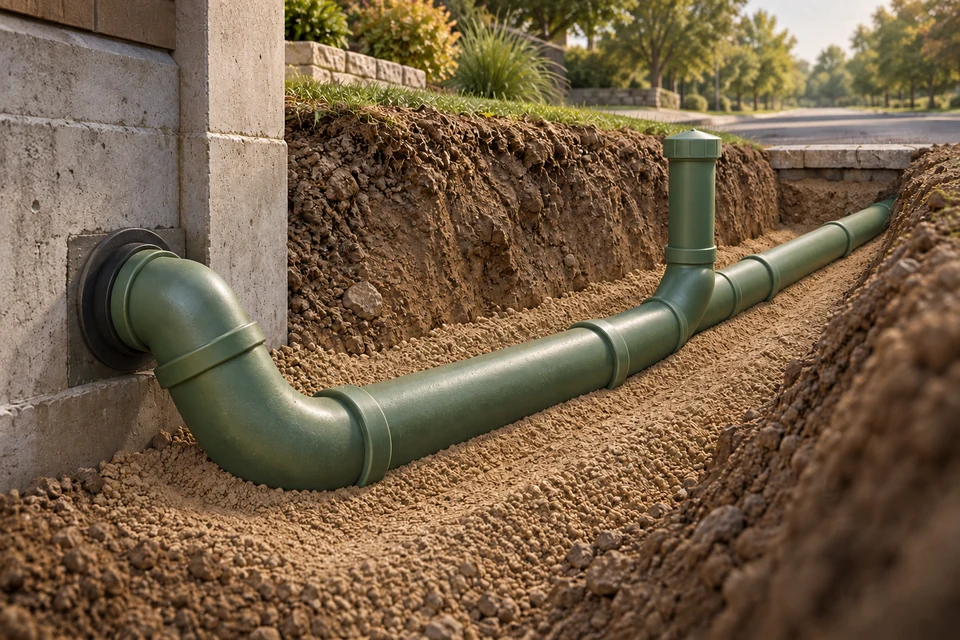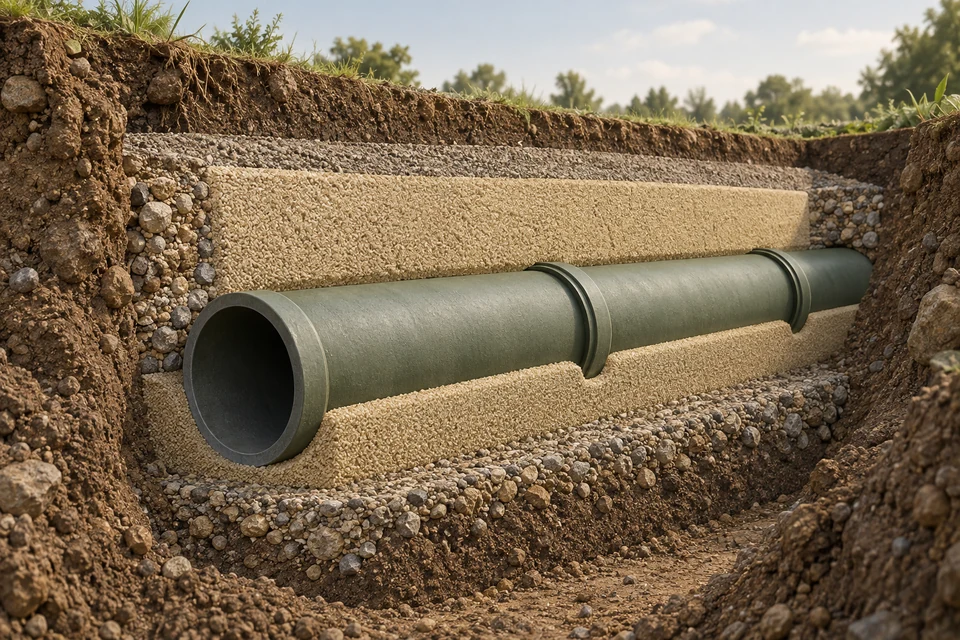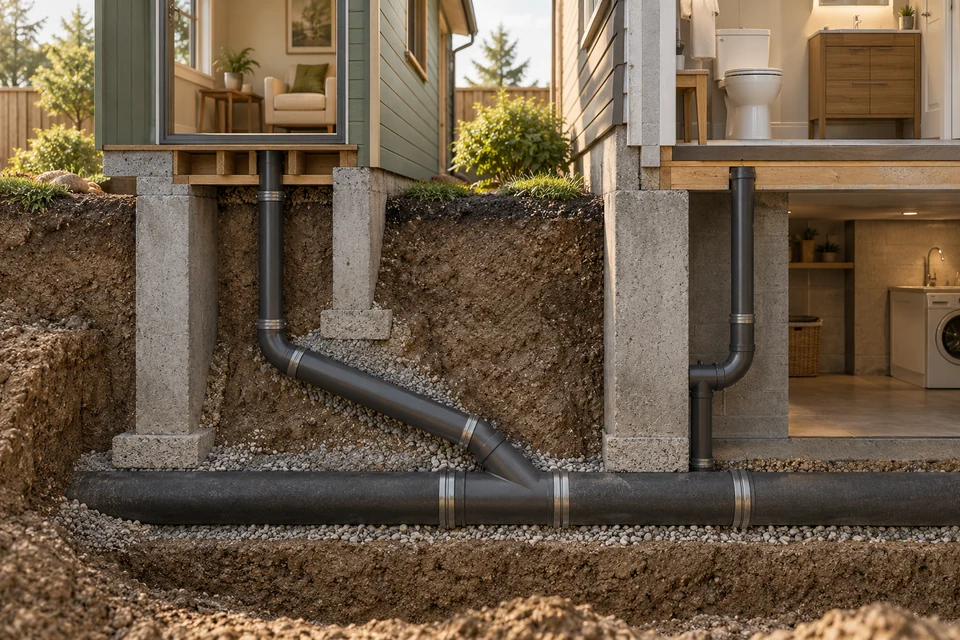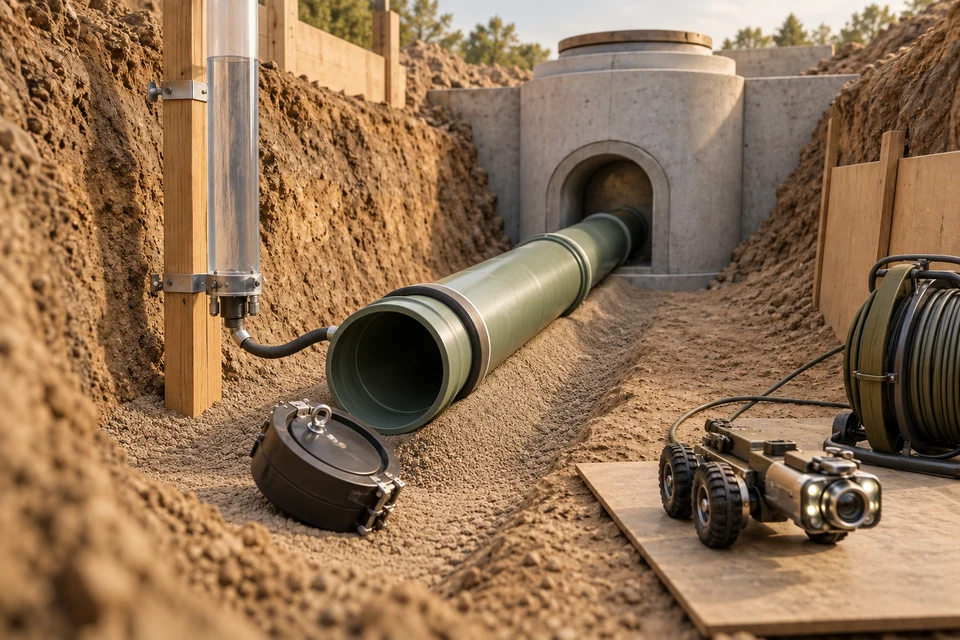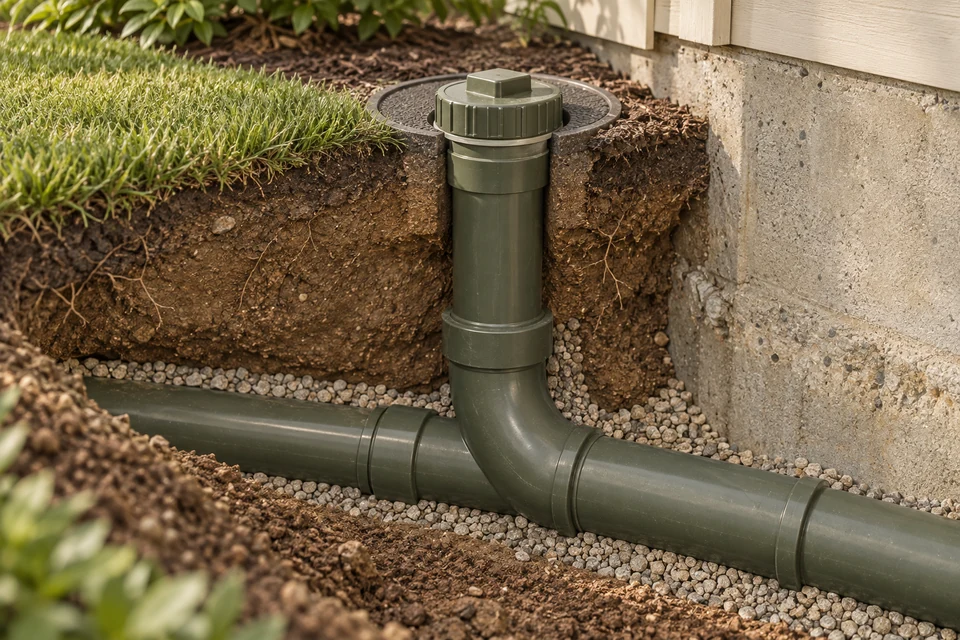
New building sewers in Canada are mostly PVC sewer pipe with gasketed bell-and-spigot joints, or ABS or PVC drain pipe with solvent-welded joints. The National Plumbing Code of Canada 2020 lists the standards plastic pipe must meet underground, including a minimum pipe stiffness of 320 kPa for sewer pipe, and requires mechanical couplings on drain and sewer pipe to meet CSA B602.
- Underground plastic drain pipe must meet one of the standards in NPC 2.2.5.9: CSA B181.1 (ABS), B181.2 (PVC), or the B182 sewer pipe series with pipe stiffness of at least 320 kPa.
- Gasketed joints are pushed to an insertion mark; solvent-welded joints need the cement for that material, or transition cement meeting CSA B181.1 or B181.2 between ABS and PVC.
- Transitions between different materials use mechanical couplings meeting CSA B602 (NPC 2.2.10.4).
- Tee fittings, crosses and saddle hubs are not used to connect drainage pipes; wyes and long bends are.
01 /Which pipe is used for a new building sewer?
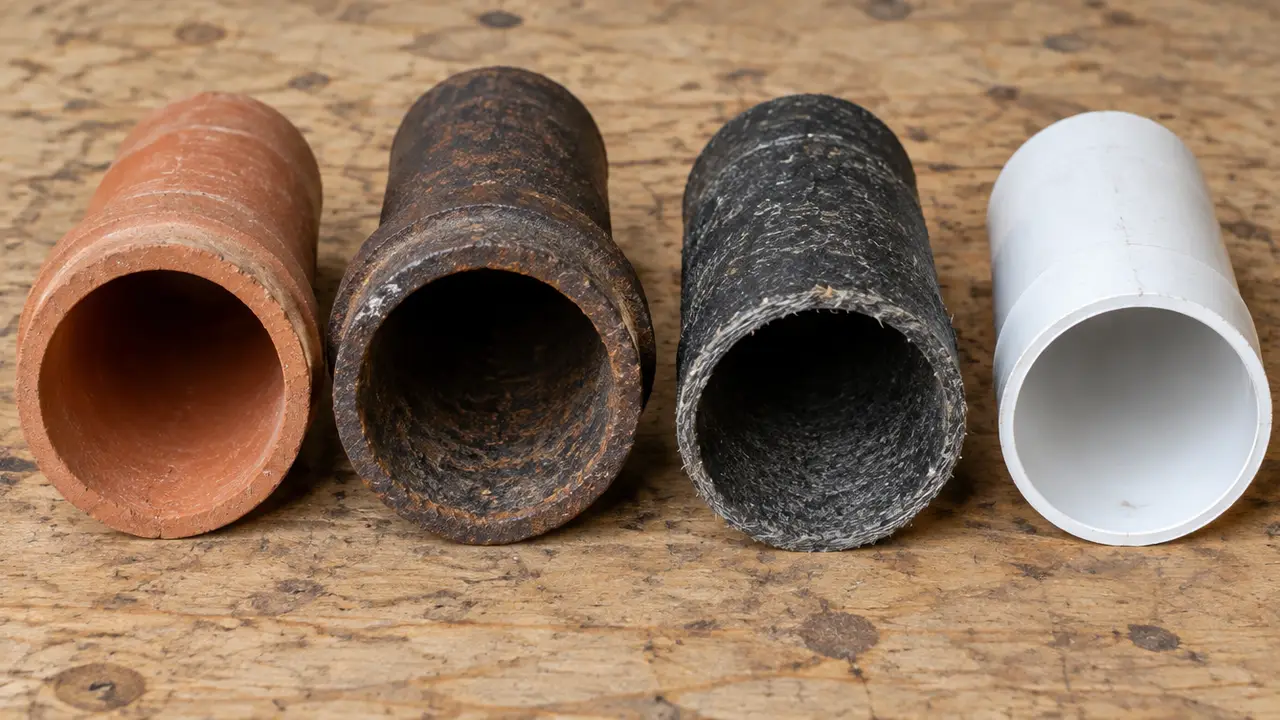
Almost always plastic. Clay and cast iron built the older neighbourhoods, and both are still allowed in some roles, but new residential sewers in Alberta are laid in PVC or ABS. The choice between them depends on local practice, the pipe the building drain is made of, and what the installer and the permit office are used to. What matters for compliance is that the pipe, fittings and cement meet one of the standards the National Plumbing Code of Canada 2020 lists for plastic used underground.
| Standard | Pipe | Condition |
|---|---|---|
| ASTM F628 | ABS Schedule 40 drain pipe with a cellular core | |
| CSA B181.1 | ABS drain, waste and vent pipe and fittings | |
| CSA B181.2 | PVC and CPVC drain, waste and vent pipe and fittings | |
| CAN/CSA-B182.1 | Plastic drain and sewer pipe and fittings | Pipe stiffness at least 320 kPa |
| CAN/CSA-B182.2 | PSM type PVC sewer pipe and fittings | Pipe stiffness at least 320 kPa |
| CAN/CSA-B182.4 | Profile PVC sewer pipe and fittings | Pipe stiffness at least 320 kPa |
| CAN/CSA-B182.6 | Profile PE sewer pipe for leak-proof sewer applications | Pipe stiffness at least 320 kPa |
| CAN/CSA-B182.8 | Profile PE storm sewer and drainage pipe | Type 1 joints and non-perforated pipe only |
The markings are printed along the pipe: the material, the size, the standard and often the stiffness or dimension ratio. Ask to see them, and check that the pipe on site matches the quote. A building sewer to a public sewer must be at least 4 inch (NPC 2.4.9.4), so the pipe on a typical house sewer is 4-inch sewer or drain pipe.
02 /How do PVC sewer pipe and ABS or PVC drain pipe differ?
Mainly in how they join and what they are designed for. PVC sewer pipe of the PSM type, often green or cream, is made for buried gravity sewers: it comes in longer lengths with a factory bell containing a rubber gasket, and it is specified by stiffness because it relies on the surrounding soil for support. ABS (black) and PVC (white or grey) drain, waste and vent pipe is made for building drainage systems and joins by solvent welding. Both kinds appear on house sewers in the Calgary region.
Where the building drain is ABS and the sewer is PVC, the joint between them is either a mechanical coupling or a solvent joint made with transition cement. The code says solvent cement for transition joints must meet CSA B181.1 or B181.2 (Article 2.2.5.10). Ordinary cement for one material does not bond the other reliably.
03 /How is each type of joint made properly?
Every joint type has a short list of things that must be right. The pipe maker's instructions govern the details, and the inspector will look at the joints in the open trench.
| Joint | Must be right | Common mistake |
|---|---|---|
| Gasketed bell and spigot | Square cut, chamfered spigot, clean gasket, maker's lubricant, pushed straight to the insertion mark | Spigot not fully home, or gasket rolled out of its groove by a crooked push |
| Solvent weld (ABS or PVC) | Square cut, deburred, dry fit, primer on PVC, the right cement, full socket depth, held briefly | Cement for the wrong material, or pipe backing out before it grabs |
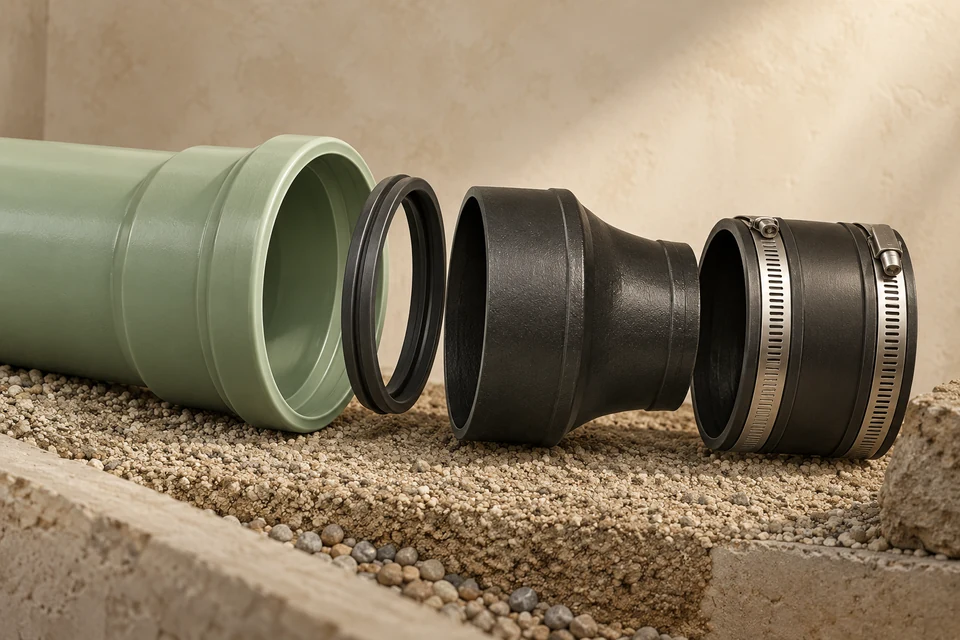
| Mechanical coupling | Coupling rated for both pipes' outside diameters, pipes centred, bands tightened to the maker's torque | Wrong size coupling or ends not butted, leaving a gap that catches solids |
| Heat fusion (HDPE) | Faced ends, correct heat, pressure and cooling time, bead on each side | Rushed cooling or dirty ends |
Joints are where roots, water and soil get into old sewers, which is why a new line's joints matter so much. A gasketed joint pushed properly home and a solvent joint made at full depth close that path. The installation order around the joints, including which way the bells face, is in how a sewer line is installed.
04 /How is new pipe joined to old clay or cast iron?
With a mechanical coupling made for the transition. The National Plumbing Code requires mechanical couplings for non-pressure applications, meaning drain, waste, vent and sewer pipe, to conform to CSA B602 (Article 2.2.10.4). These couplings are rubber sleeves, often with a stainless steel shield and band clamps, sized so each end matches the outside diameter of the pipe it grips. Old clay, cast iron and new plastic all have different outside diameters for the same nominal size, so the coupling must be ordered for the actual pipes, not just the nominal size.
Two things decide whether a transition lasts. First, the old pipe must be sound at the joint: cut back to solid material, not crumbling clay or scaled iron. Second, the inverts must line up, so there is no step for solids to catch on. On a replacement, the transition is usually near the property line or at the foundation. Photographs of the transition before backfill are worth having.
05 /Which fittings are allowed on a sewer?
Fittings that change direction gradually. The code prohibits a T fitting in a drainage system except to connect a vent pipe, prohibits cross fittings in drainage outright (Article 2.2.4.1), and prohibits a sanitary T in a nominally horizontal sanitary drain except to connect a vent (2.2.4.2). Short 90-degree elbows on sanitary drains of NPS 4 or less are limited to a few situations, such as turning from horizontal to vertical in the direction of flow (2.2.4.3). Saddle hubs are not allowed in drainage systems at all (2.2.10.5).
- Branches join with wyes (Y fittings) or combination wye and eighth bends, pointed downstream.
- Changes of direction on the sewer use long-radius bends: 22.5 and 45-degree fittings, within the code's limits between cleanouts.
- No saddle taps: a new branch is cut in with a proper wye, not strapped onto a hole in the pipe.
- Cleanout fittings must be able to withstand removal and reinstallation and seal gas-tight (NPC 2.2.10.3).
Tie-ins for additions and suites are where these rules are most often broken, which is why they have their own guide: tie-ins for additions and suites.
06 /Where does HDPE fit?
Mainly in trenchless renewal. The code allows polyethylene pipe underground outside a building for rehabilitating existing drainage systems by trenchless methods if it conforms to ASTM F714 and is HDPE 3408, SDR 11 or heavier (Article 2.2.5.5). Its explanatory note says joints within HDPE are heat-fused to the maker's instructions and joints to other materials use a suitable hubless coupling. That is the pipe pulled in by pipe bursting, covered in depth on sister site PipeBursting.ca. For a new open-trench house sewer, PVC or ABS remains the usual choice.
07 /What about clay, cast iron and concrete today?
They are still in the code but rarely chosen for new house sewers. Vitrified clay pipe must conform to CSA A60.1-M and may only be used for an underground part of a drainage system. Cast iron drainage pipe must conform to CSA B70. Concrete sewer pipe must conform to CSA A257.1 or A257.2 and may not be used above ground inside a building. In practice they appear on new work mainly at larger sizes or where a municipality specifies them, and on house sewers as the old pipe a new line has to join.
If you are not sure what your existing pipe is, a camera scope settles it. For planning a new line, the installation cost guide puts pipe material in context: it is a small part of the total. Ready to talk specifics? Send the details.
FAQQuestions people ask
Is PVC or ABS better for a sewer line?
Both are allowed underground when they meet the listed standards. Gasketed PVC sewer pipe is common outside the foundation; solvent-welded ABS or PVC is common under the slab.
Can ABS be glued to PVC?
Only with transition solvent cement meeting CSA B181.1 or B181.2 (NPC 2.2.5.10), or with a CSA B602 mechanical coupling.
What is SDR 35 sewer pipe?
A dimension ratio commonly printed on PVC sewer pipe. The plumbing code specifies underground sewer pipe by standard and minimum pipe stiffness, 320 kPa, so check the printed standard.
Can I use a tee to connect a new drain to my sewer?
No. The code does not allow a T fitting to connect drainage pipes; use a wye pointed downstream. Saddle hubs are not allowed either.
What coupling joins clay pipe to PVC?
A mechanical coupling meeting CSA B602, sized for the outside diameter of each pipe.
NETWORKGo deeper across the HAUSE Sewer network
Cast iron drain pipe explained: joints, sizes, lead and cutting
What is cast iron drain pipe? How it is made, joined and sized, whether old joints contain lead, and how cast iron is cut and connected to plastic safely.
Is hydro jetting safe for PVC and ABS drain pipe?
Can hydro jetting damage PVC or ABS pipe? What plastic lines tolerate, where they are weak (joints, fittings, bellies, heat) and how to jet them safely.
How to snake a sink drain from the trap arm, not the plughole
How to snake a sink drain: pull the P-trap, feed 1/4-inch cable into the trap arm, get it down the tee, and handle double basins and garbage disposals.