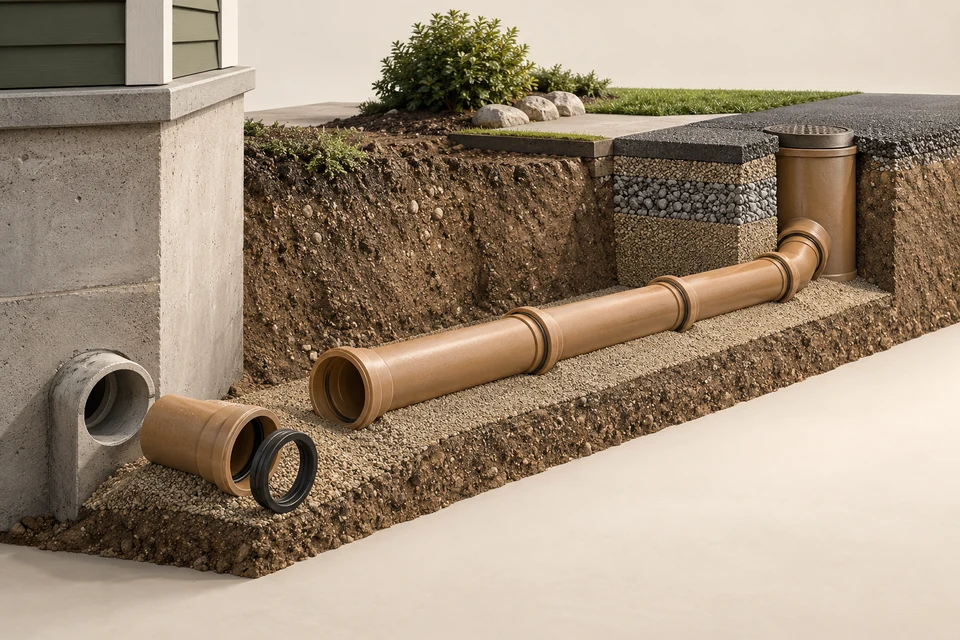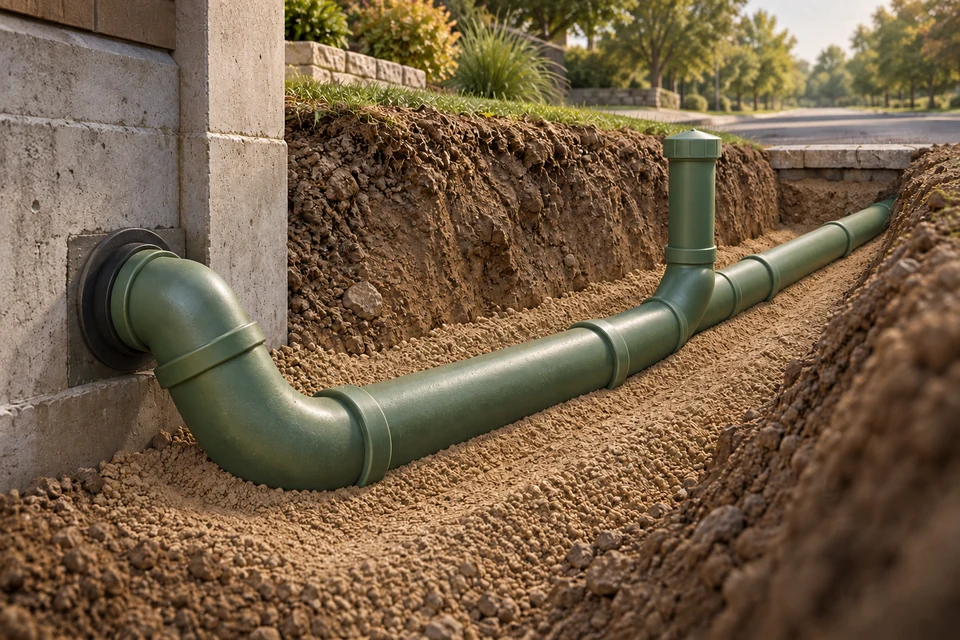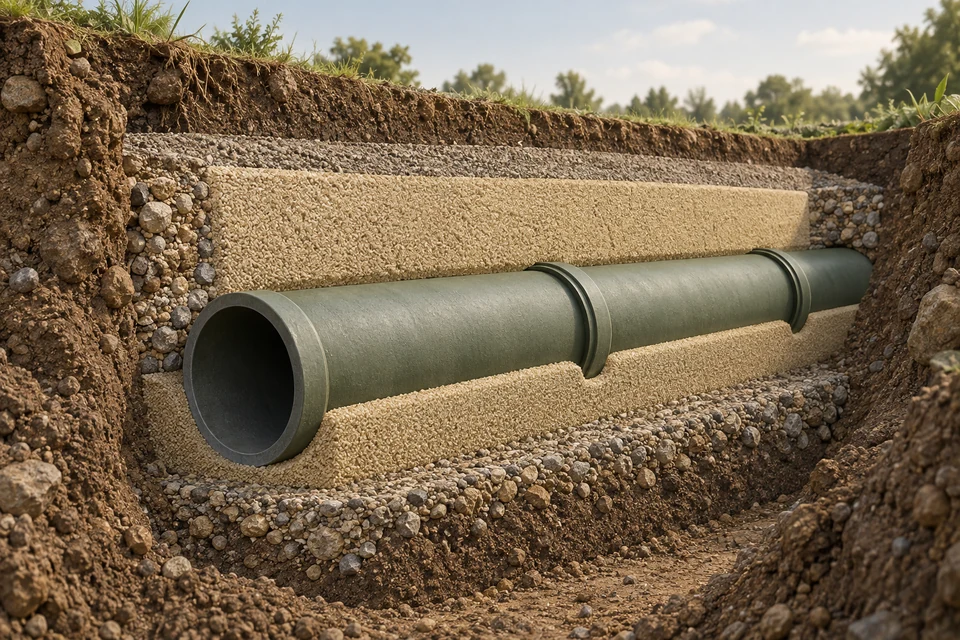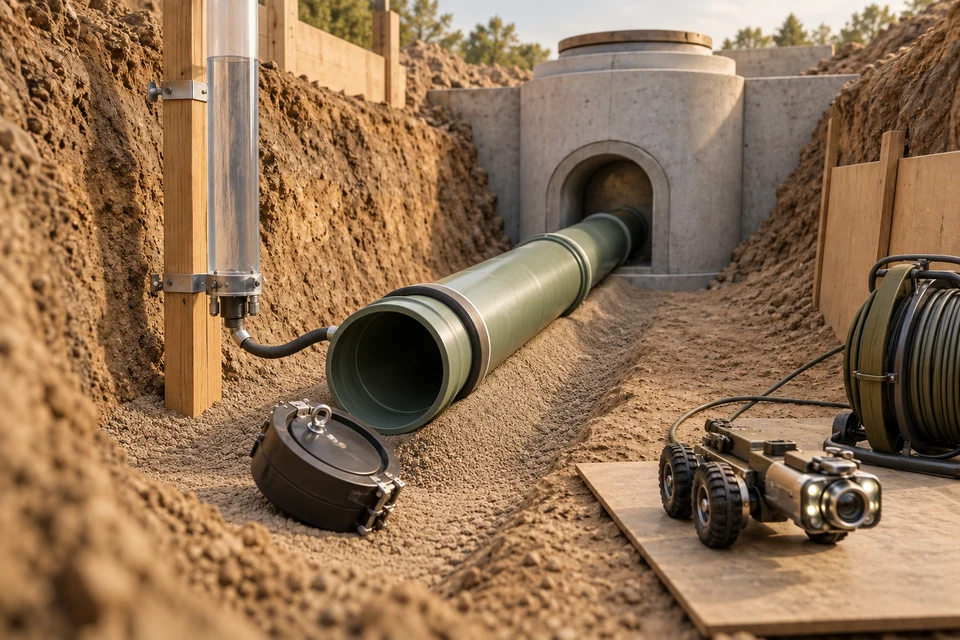
A new sewer line is tested and inspected while the trench is still open. The National Plumbing Code of Canada 2020 requires a water test holding at least a 3 m column on all joints for 15 minutes, or an air test holding 35 kPa for at least 15 minutes, before piping is covered, with a ball test on request. Calgary then inspects sanitary services at the pre-backfill stage.
- Water test: at least a 3 m water column on all joints, kept full for 15 minutes (NPC 2.3.6.4).
- Air test: 35 kPa held at least 15 minutes without a drop, following the pipe maker's instructions (NPC 2.3.6.5).
- Ball test: a dense ball rolled through the pipe, when the authority requests it (NPC 2.3.6.7).
- Calgary generates sanitary and storm inspections at the pre-backfill stage; do not cover pipe before sign-off.
01 /Why is a sewer tested before it is buried?
Because it is the last moment anyone can see it. Once the trench is backfilled, a leaking joint, a pipe out of grade or a missing cleanout can only be found with a camera and fixed with an excavator. The plumbing code builds the timing into the rule: Article 2.3.6.1 says that after a section of a drainage or venting system has been roughed in, and before any fixture is installed or piping is covered, a water pressure test or an air pressure test shall be conducted. The inspection that follows is the authority's check that the work, and the test, meet the code.
Testing protects everyone. The owner gets a line that is proven tight and continuous. The installer gets a clean record that the work was right on the day it was covered. The municipality gets assurance that groundwater is not leaking into the sanitary system and sewage is not leaking out. A contractor who suggests skipping the test to save a day is suggesting you accept an unproven pipe.
02 /What tests does the plumbing code set out?
Four, in Subsection 2.3.6 of the National Plumbing Code of Canada 2020, which Alberta enforces without changes. The code says drainage pipes must be capable of withstanding the water, air and final tests without leakage, and of meeting a ball test (Article 2.3.6.2).
| Test | How it works | Pass condition | When |
|---|---|---|---|
| Water pressure test (2.3.6.4) | Every opening except the highest is plugged or capped; the section is filled so there is a water column of at least 3 m on all joints | Kept filled for 15 min without leakage | After rough-in, before covering; this or the air test |
| Air pressure test (2.3.6.5) | Air is forced into the plugged section, following the maker's instructions for the pipe | 35 kPa held at least 15 min without a drop | After rough-in, before covering; this or the water test |
| Final test (2.3.6.6) | Traps filled; smoke forced in, roof terminals closed when smoke appears, or air alone | 25 mm water column held 15 min without adding smoke or air | After fixtures are installed, when requested |
| Ball test (2.3.6.7) | A hard ball dense enough not to float is rolled through the pipe | The ball passes | When requested |
03 /How is a water test done on a sewer?
By plugging the downstream end and filling the pipe until water stands high enough to put at least 3 m of head on every joint. On a building sewer, that usually means a test plug at the far end and a standpipe or the building's own riser at the high end, filled until the level is 3 m above the joints being tested. The section stays filled for 15 minutes, and the level must hold. Any drop means a leak, which is then found by looking along the open trench for water at the joints.
A long sewer on a steep grade can be hard to test in one piece, because 3 m of head at the top can be much more at the bottom. Installers test in sections in that case, with plugs between. A water test is not a good idea in freezing weather unless the water is drained promptly; in winter, the air test is often preferred where the pipe maker allows it.
04 /When is an air test used, and what are the risks?
An air test is used where water is impractical: cold weather, long sections or where filling and draining would be messy. The code says air tests shall be conducted in accordance with the manufacturer's instructions for each piping material, with air forced in until the pressure reaches 35 kPa and held for at least 15 minutes without a drop. Its explanatory note adds that a non-toxic indicating substance such as an aerosol, fluorescent dye, smoke or odorant may help find a leak, as long as it is compatible with the pipe and does not affect the result.
A test plug that slips under pressure is also a hazard. Plugs are rated for a pressure and pipe size; using the wrong one, or one not fully seated, is how plugs are launched out of pipes. None of this is exotic, but it is why a test is done carefully and not rushed at the end of a long day.
05 /What does the inspector check in the open trench?
The inspector checks that the installation matches the code and the permit, and that the test has been done or is done in front of them. In Calgary, sanitary and storm inspections are generated automatically at the pre-backfill stage, and inspection requests for the following day are due by 2 p.m. through 311 or an online account. Around Calgary the process differs in detail: Cochrane's homeowner guide describes a groundworks rough-in and a mandatory final, Foothills County requires a rough-in of drain, waste and vent piping below the slab to outside the building, and Chestermere asks for 2 to 3 business days' notice.
| Item | What the inspector wants to see |
|---|---|
| Pipe and fittings | Material and markings meeting a listed standard; wyes, not tees; no saddle hubs |
| Size | At least 4 inch for a building sewer connected to a public sewer |
| Grade | At least the minimum for the size, steady, no dips |
| Support | Firm, continuous bedding; no blocks or stones under the pipe |
| Cleanouts | Main cleanout near the building and spacing and bend rules met |
| Backflow protection | Backwater valve where the authority requires one |
| Cover | Depth consistent with the local frost rule |
| Test | Water or air test holding |
Calgary's quick trench program for new single and semi-detached homes lets qualified contractors document a trench with photographs, uploaded before backfill, showing site location, pipe size and material, backfill material and location markings. Even where that program applies, the record has to exist before the trench is closed.
06 /Why do sewer lines fail inspection?
Usually for one of a short list of reasons, most of which are cheap to fix before backfill and expensive after.
- The test does not hold: a gasket not fully home, a solvent joint not seated, a coupling band loose, or a test plug leaking.
- Grade problems: a section flatter than the minimum, a dip over a soft spot, or a change of slope between cleanouts.
- Wrong fittings: a tee or a short elbow where a wye or long bend is required, or a saddle tap into an existing pipe.
- Missing or misplaced cleanouts: no cleanout near the building, or bends beyond the allowance without one.
- Bedding and support: pipe on rocks or blocks, or no bedding under part of the run.
- Paperwork: no permit posted, or work covered before the inspection was booked.
A failed inspection is not a disaster if the trench is still open: the item is corrected and the inspector returns. It becomes costly when the work was covered first. The laying sequence that avoids most of these is in how a sewer line is installed, and the bedding rules are in bedding and backfill.
07 /Should you also get a camera record of the new line?
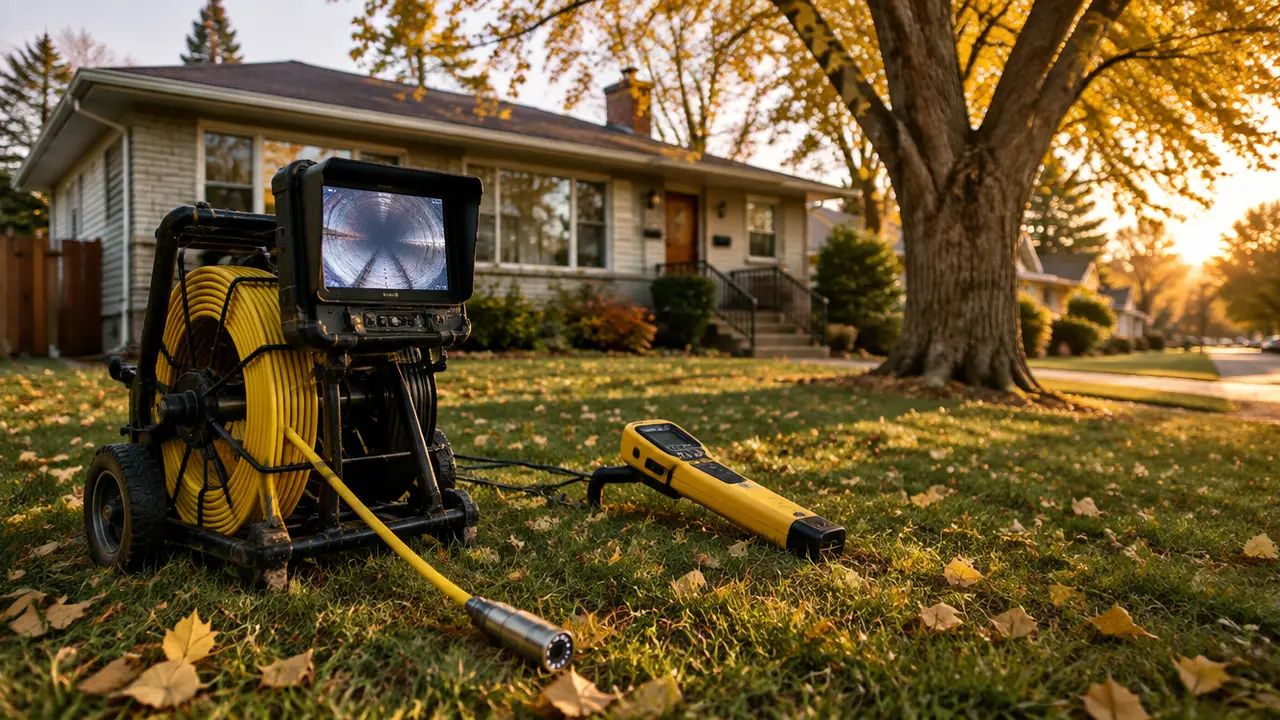
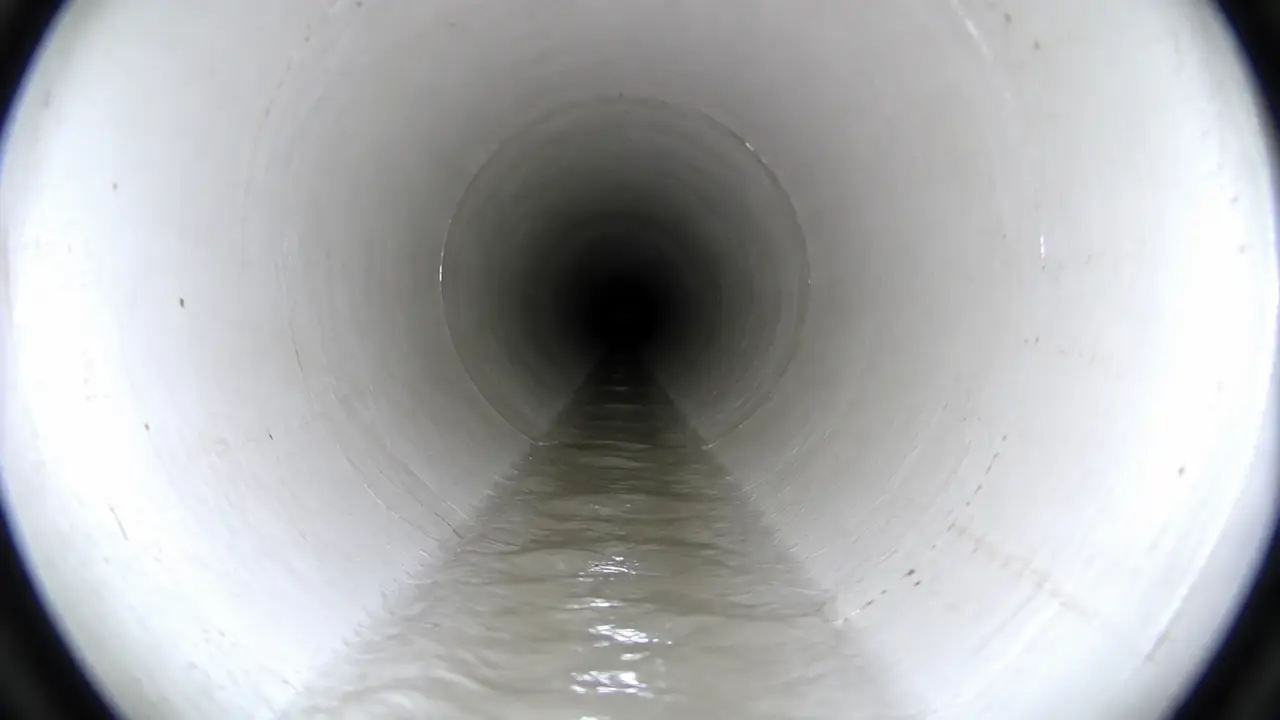
It is worth asking for. A camera run after laying, and ideally after backfill, shows the grade, every joint and the connection, and gives the owner a video baseline for the life of the pipe. It can catch a joint displaced by backfilling or a section that settled, which the pre-backfill test cannot, because it happens after. It is not one of the code tests and does not replace them; it complements them. Sister-site planning ranges put a post-work camera video at $0 to $400 when included in a job.
Keep the test record, the inspection sign-off and the video together with the permit. For the full job order, see the installation process; for what a camera inspection of an older line involves, SewerInspector.ca covers report codes and defect reading. When you are ready to plan, send the details.
FAQQuestions people ask
How long does a sewer water test last?
The section is kept filled with at least a 3 m water column on the joints for 15 minutes under NPC 2020 Article 2.3.6.4.
What pressure is used for a sewer air test?
35 kPa, held for at least 15 minutes without a drop, following the pipe maker's instructions (NPC 2020 Article 2.3.6.5).
What is a ball test on a drain?
A hard ball dense enough not to float is rolled through the pipe to show it is clear and continuous. The authority can request it.
Can I backfill my sewer before the inspection?
No. Calgary generates the sanitary inspection at the pre-backfill stage, and covering the pipe first usually means exposing it again.
Is a camera inspection required for a new sewer?
Not by the plumbing code, which relies on water, air and ball tests. A camera record is still a sensible addition for the owner's file.
NETWORKGo deeper across the HAUSE Sewer network
What causes sewer backup, and how to tell which cause is yours
What causes sewer backup: roots, grease, wipes, sags, broken pipe, frozen lines and rain-overloaded city sewers, plus how to tell which one caused yours.
What is hydro jetting, and how does it clean a sewer line?
What hydro jetting is: how a sewer jetter uses rear-facing jets to pull a hose up the line, scour the pipe wall and flush debris out. Plain physics.
Sewer scope on a new build: what goes wrong in brand-new sewer lines
Is a sewer line inspection necessary for new construction? What goes wrong in new laterals, when to scope before warranty dates, and what to ask the builder.