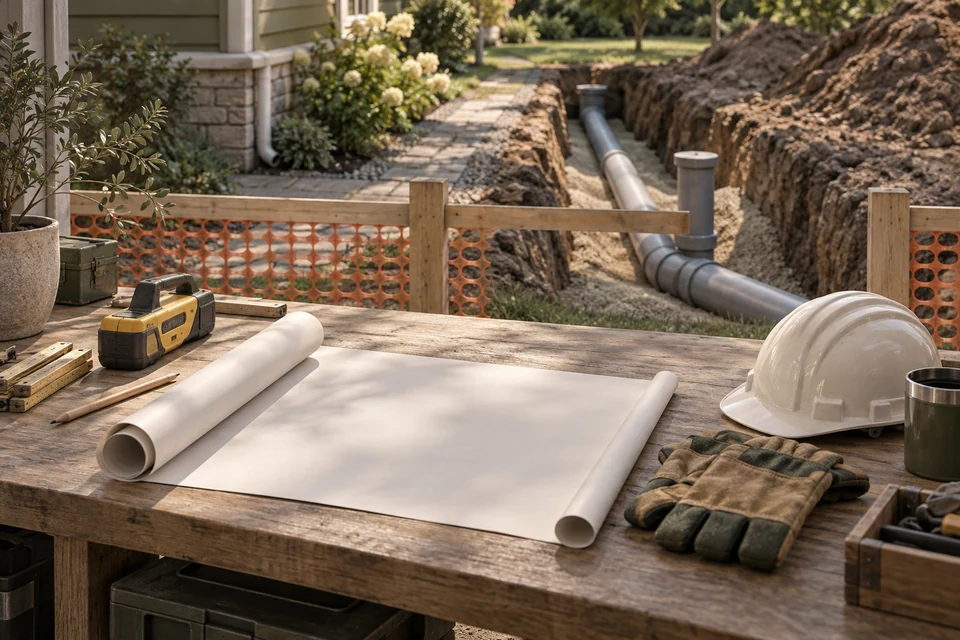
In Calgary a homeowner may apply for a plumbing permit for their own home, and Cochrane publishes a guide for homeowner plumbing permits, so installing your own sewer line is legal in principle. The work must still meet the National Plumbing Code, pass a test and a pre-backfill inspection, and follow Alberta's trench safety rules, which is why most owners hire the excavation and pipe work.
- Calgary says homeowners may apply for all permit types except gas; Cochrane publishes a homeowner plumbing guide.
- Homeowner work is inspected to the same code as a contractor's: grade, bedding, fittings, cleanouts and a water or air test.
- Trenches deeper than 1.5 m need cut-back or supported walls under Alberta's OHS Code, and most house sewers are deeper than that.
- Realistic owner tasks are planning, locates paperwork, records and restoration; the trench and the pipe are for experienced crews.
01 /Is it legal to install your own sewer line in Alberta?
Generally yes, for your own home, with a permit. The City of Calgary's plumbing and gas permit page says homeowners may apply for all permit types except a gas permit. Cochrane's homeowner plumbing guide sets out the inspections a homeowner permit needs, including a groundworks rough-in and a mandatory final, and notes that homeowner permits cannot be issued for work that was concealed before a permit was obtained.
The permit does not lower the standard. Homeowner work is built to the National Plumbing Code of Canada 2020, the same code a licensed plumber follows, and it is inspected the same way. Municipalities can set conditions on homeowner permits, so ask what yours requires before you plan. Check with your municipality before planning around doing it yourself.
02 /What will the inspector expect from a homeowner?
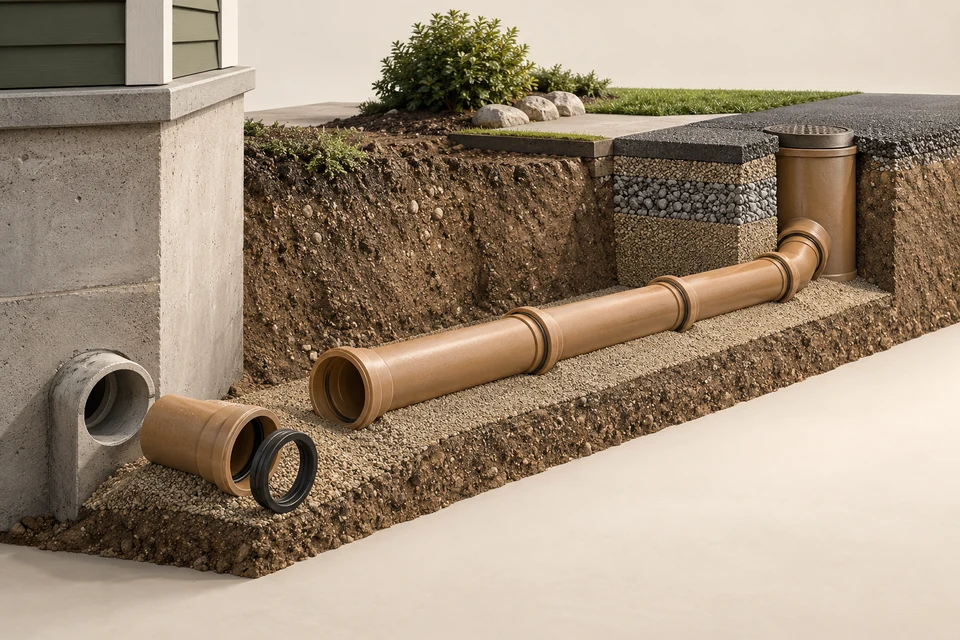
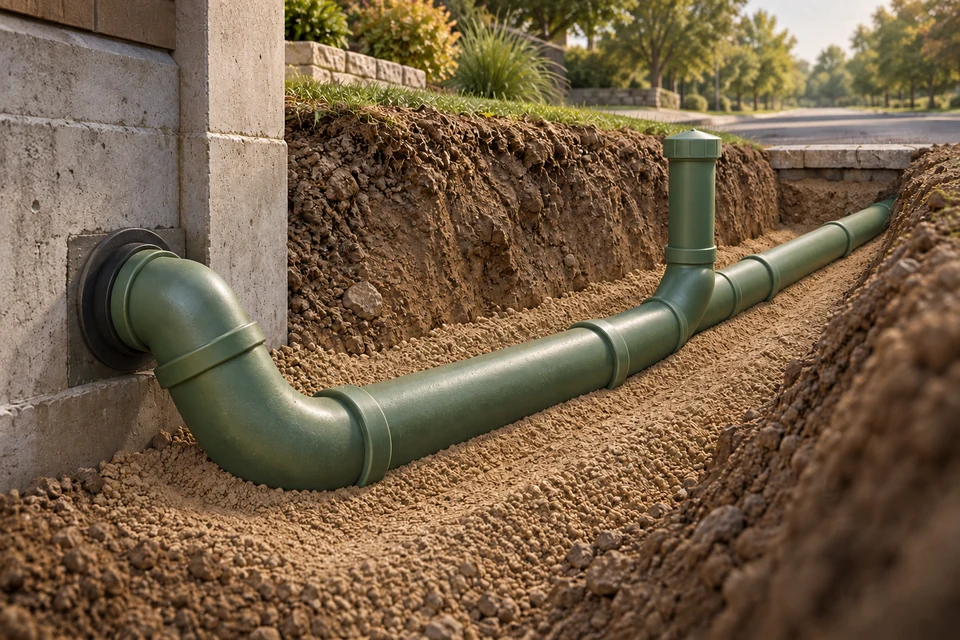
Exactly what they expect from anyone. The pipe must be a material listed for underground use, joined with the correct method; laid on a firm, continuous bed; sloped at least 1 in 100 for a 4-inch building sewer; fitted with wyes rather than tees; given a main cleanout of NPS 4 or larger near the building and further cleanouts where length or bends require them; and tested with a water column of at least 3 m on the joints or an air test at 35 kPa, each held 15 minutes. In Calgary the inspection happens at the pre-backfill stage, and the local cover and bedding rules apply as well.
| Requirement | Code or local source | Common DIY slip |
|---|---|---|
| Minimum slope | NPC 2020 Table 2.4.10.6.-C; Calgary infill page | Grade set by eye, a dip over soft fill |
| Continuous support | NPC 2.3.4.6 | Pipe propped on bricks or on its bells |
| Backfill over the pipe | NPC 2.3.5.1; Calgary bedding spec | Rocky spoil dumped straight on the pipe |
| Fittings | NPC 2.2.4.1, 2.2.4.2, 2.2.10.5 | A tee or a saddle hub at the tie-in |
| Cleanouts | NPC 2.4.7.1 and Table 2.4.7.2 | No cleanout near the building |
| Test | NPC 2.3.6.4 or 2.3.6.5 | Plug slips, joints not fully home |
| Cover | Calgary: 4.5 ft over sanitary services | Pipe shallow under a driveway |
Every item on that list is explained on this site: slope, bedding, materials and joints, cleanouts and testing.
03 /Why is the trench the hard part?
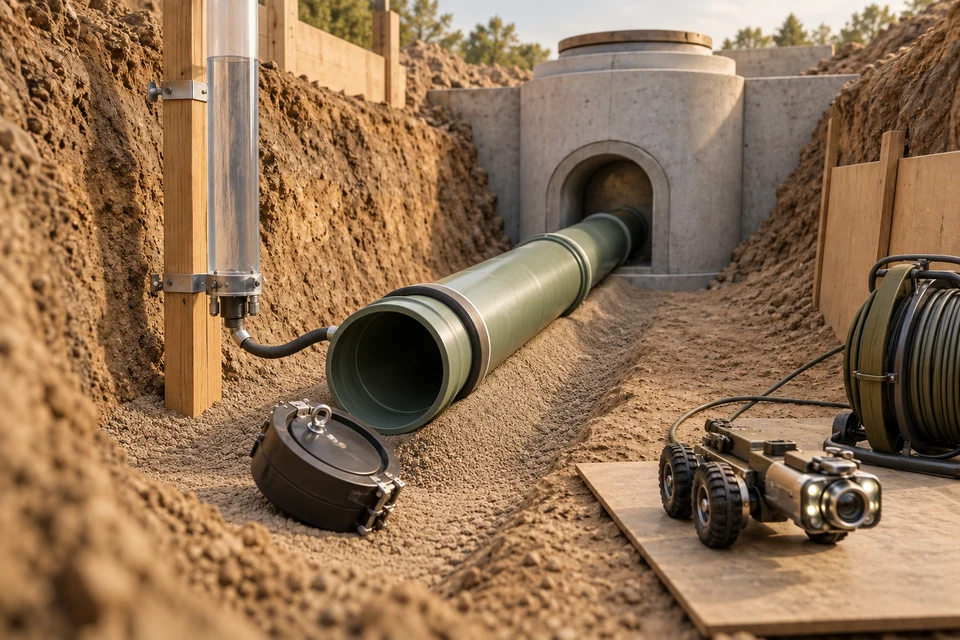
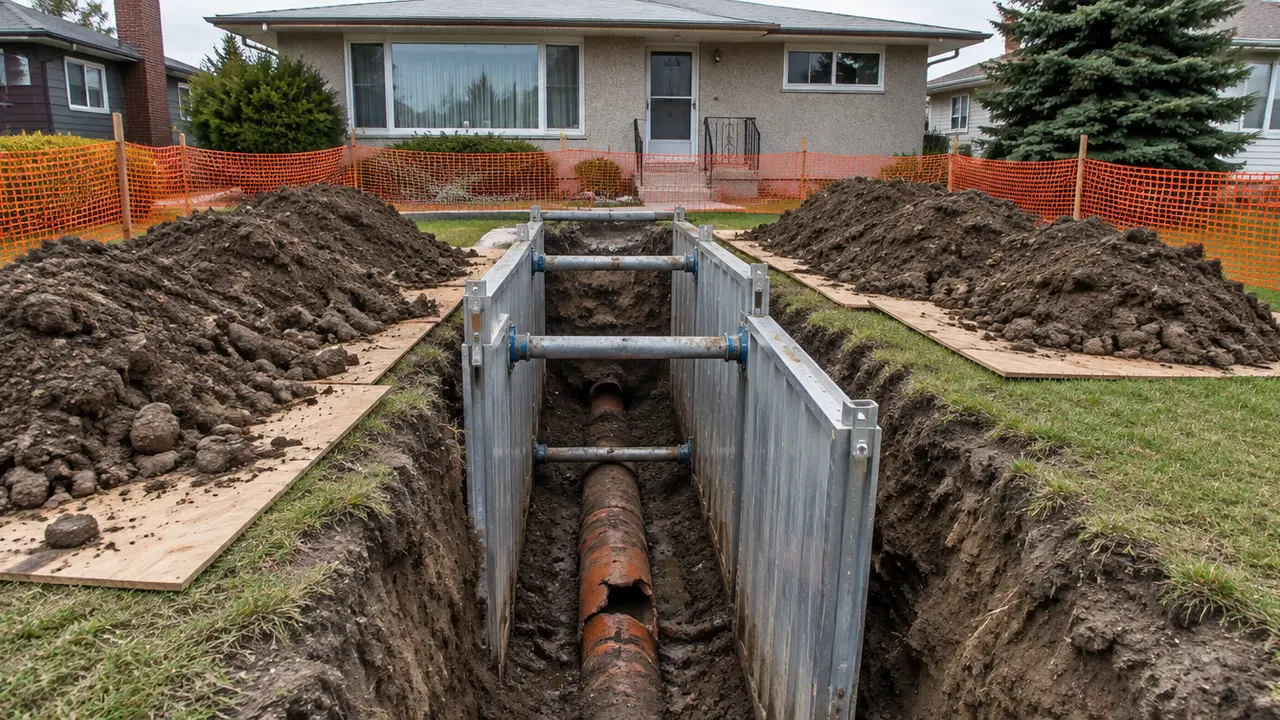
Because it can kill you, and it is where most of the cost and skill sit. A house sewer in the Calgary region is usually deeper than 1.5 m at one end, because it leaves under a basement and needs frost cover. Alberta's OHS Code Part 32 requires trench walls deeper than 1.5 m to be cut back or supported by a temporary protective structure before workers go in, and a protective structure for an excavation deeper than 3 m must be designed and certified by a professional engineer. Soil that looks firm collapses without warning, and a cubic metre of it weighs well over a tonne.
Then there are the utilities. Utility Safety Partners asks for at least three full working days' notice for a routine locate request and states that you are not clear to excavate until every utility has been located. Marked lines near the dig need hand exposure before a machine works close to them. Private lines are not marked by the member utilities and need a private locator.
04 /What parts can a homeowner sensibly do?
Plenty, and doing them well saves real money and time. The owner is often the best person to gather information, handle the paperwork, prepare the site and restore it afterwards. What the owner should hand to experienced people is the deep trench, the pipe laying to grade, the tie-in to existing pipe and the test.
Short, shallow, above-slab or interior drain work is a different matter: a handy owner with a homeowner permit can often manage a basement rough-in extension, as long as the test and inspection come first. The under-slab steps are in sewer lines under a slab.
05 /What should a homeowner check before deciding?
Run through five questions honestly. If any answer is "no" or "not sure", hire that part out and keep the rest.
- Is the permit yours to hold?
The work is on your own home and your municipality issues homeowner plumbing permits. Rentals and work for others usually are not.
- Does gravity work?
You know the connection invert and the house-end invert, and the Sewer Slope & Fall Calculator shows enough fall at the code minimum.
- Can the trench be made safe?
You have a plan and the equipment to cut back or support any wall deeper than 1.5 m, and nobody will enter until it is done.
- Are the utilities cleared?
The locate request is in with at least three full working days' notice, every utility has responded, and private lines have been located.
- Can you test it?
You have the right plugs and gauge for a water or air test, and you know the pipe maker's instructions for air testing.
Owners who pass all five are usually people with trade or construction experience. Everyone else still gains by understanding the work: it makes quotes easier to compare and the installer easier to supervise.
06 /How much does doing it yourself really save?
Less than people expect on a full sewer. The pipe and fittings are a small share of the job; sister-site planning ranges put material at roughly $30 to $120 per metre, while new-service trenching typically quotes $600 to $1,000 per metre shallow and $1,000 to $2,000 per metre deep or under hard surfaces. Much of that difference is excavation, shoring, compaction and disposal, which a homeowner still has to pay for as equipment rental, trench box rental, material delivery and hauling, and a failed inspection means doing it twice.
Where owners do save is on the parts in the left column above, and by getting three contractors to price exactly the same scope. The installation cost guide lists the line items to compare.
07 /What happens if work is done without a permit?
It comes back to you. Cochrane's guide is explicit that homeowner permits cannot be issued for work concealed before a permit was obtained, that a licensed plumbing contractor must then be hired to proceed with inspection, and that the homeowner remains accountable for the previously concealed work. In practice that can mean exposing buried pipe so it can be inspected. Unpermitted sewer work can also surface when the house is sold, or after a backup when an insurer asks what was done and by whom.
Permits are inexpensive relative to the work, and the inspection is a free second pair of eyes on a pipe you will depend on for decades. If you want help deciding which parts to take on, send the details and the desk will reply, or start with the installation process.
FAQQuestions people ask
Can a homeowner get a plumbing permit in Calgary?
Yes. Calgary's permit page says homeowners may apply for all permit types except gas, for work on their own home.
Do I need a licensed plumber to connect to the city sewer?
Not necessarily for the private side under a homeowner permit, but the municipal connection itself may have its own requirements. Ask the municipality.
What is the most dangerous part of installing a sewer line?
The trench. Walls deeper than 1.5 m must be cut back or supported in Alberta, and unsupported trenches can collapse without warning.
Can I lay the pipe myself and have a contractor dig?
Sometimes, if the permit arrangement allows it. It is often simpler for one party to hold the permit and be responsible for the whole installation.
NETWORKGo deeper across the HAUSE Sewer network
Backwater valve installation cost and municipal subsidies
Backwater valve installation cost in Canada for 2026: CAD ranges for unfinished and finished basements, line items, subsidy program patterns and insurance angles.
Sewer camera inspection certification and training: what it proves
Sewer camera inspection certification and training in Canada: NASSCO PACP and LACP, home inspector courses, safety training and what a credential proves.
Cast iron drain pipe explained: joints, sizes, lead and cutting
What is cast iron drain pipe? How it is made, joined and sized, whether old joints contain lead, and how cast iron is cut and connected to plastic safely.