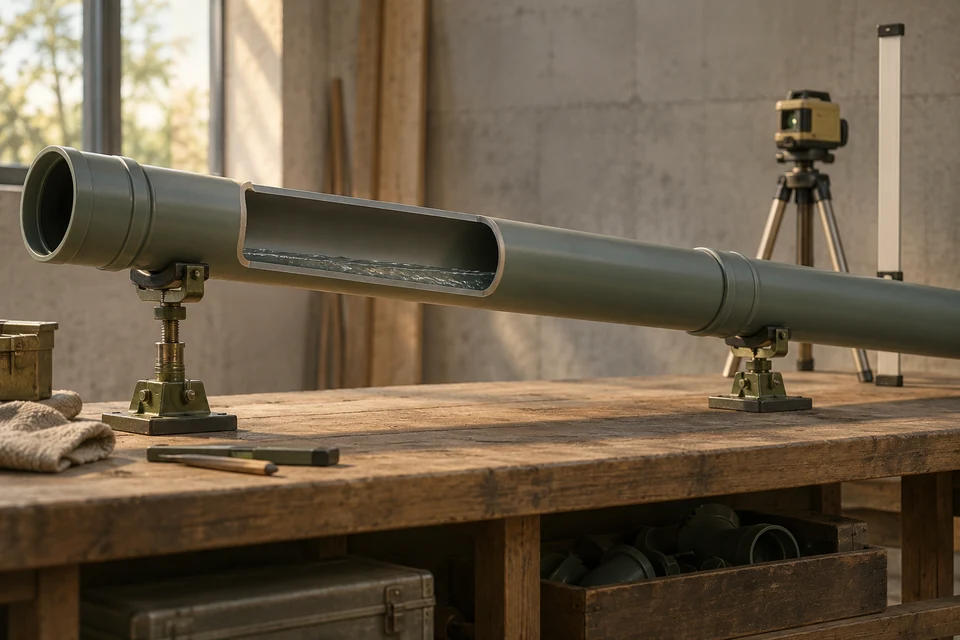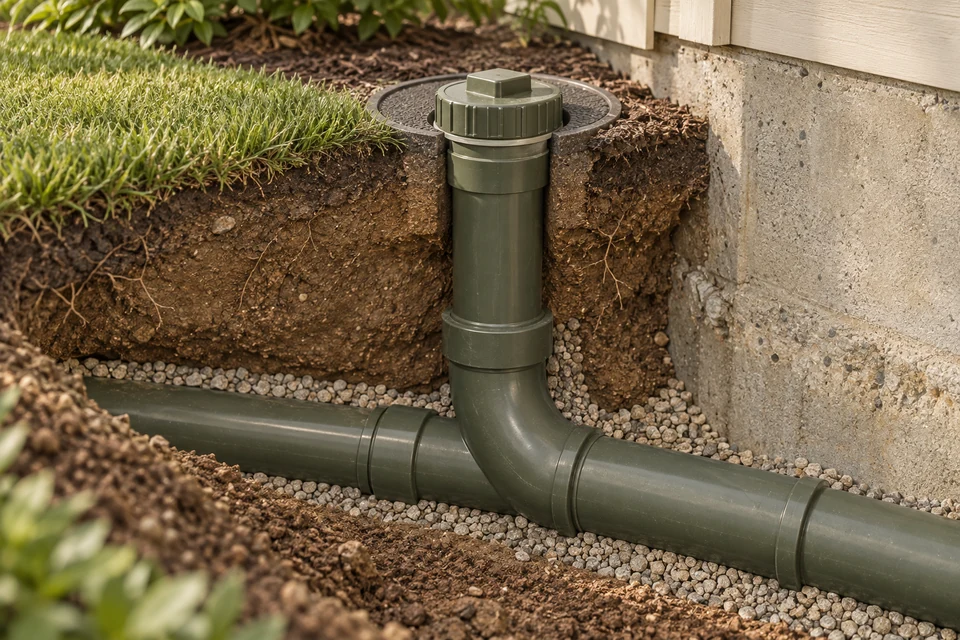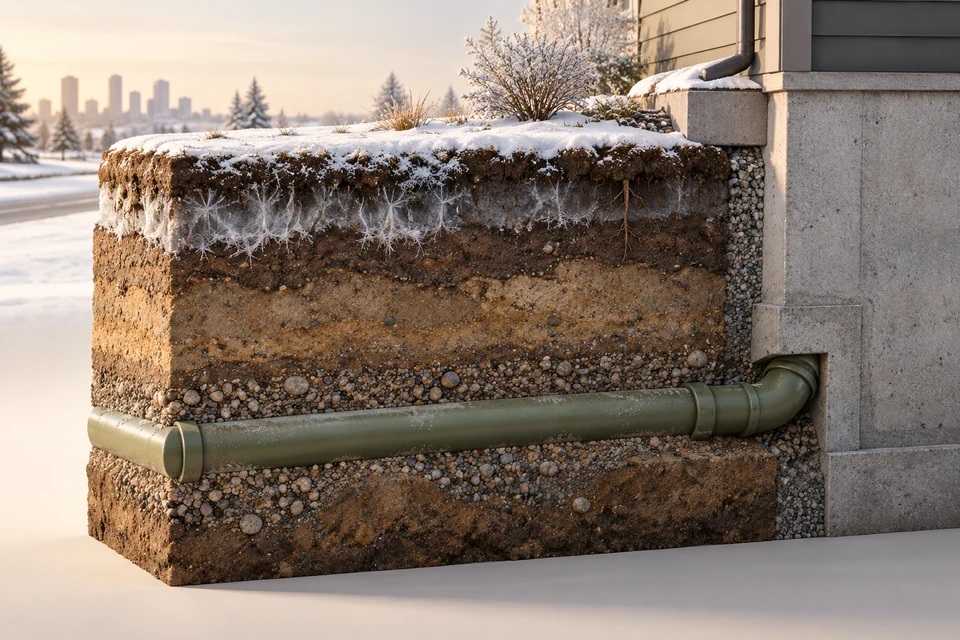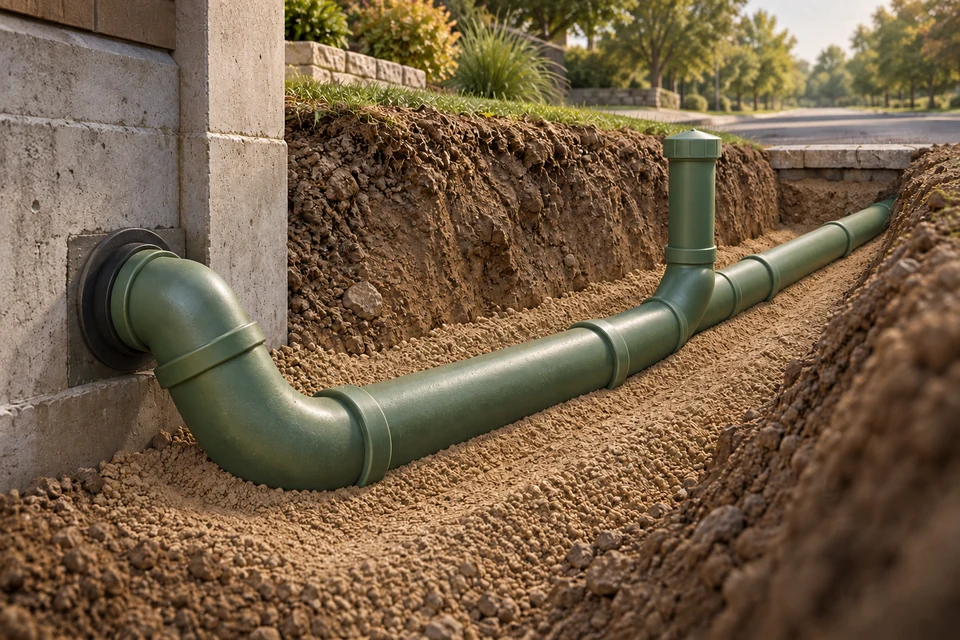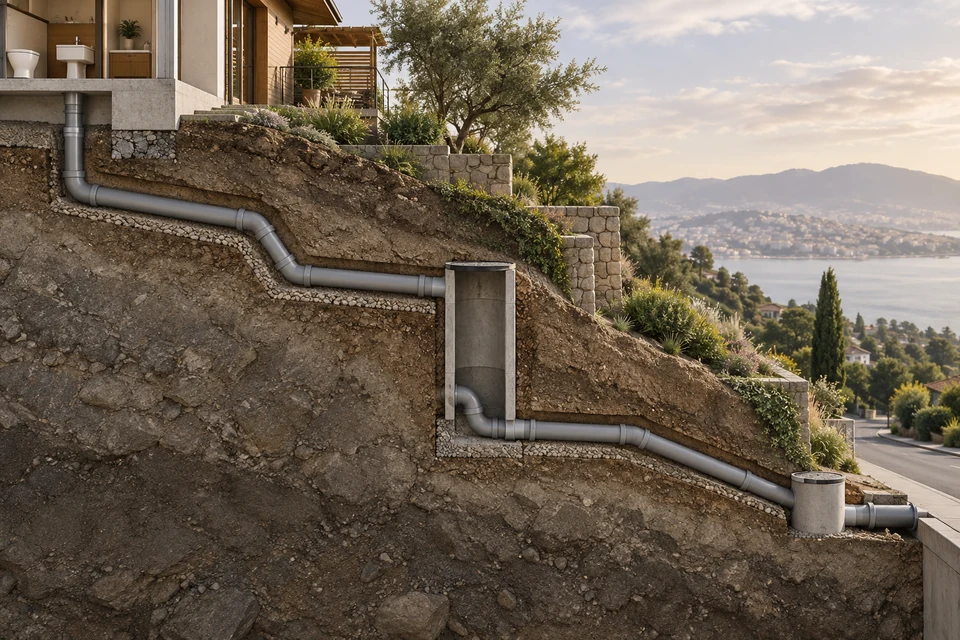
On a steep lot, a sewer can simply follow a steeper slope, because the National Plumbing Code of Canada sets minimum slopes and no maximum. The limits are elsewhere: a building sewer may not change slope or direction between cleanouts except within set bend allowances, so each change of grade needs a cleanout, and a lot that falls away from the sewer may need a pump instead.
- There is no maximum slope in the NPC; the explanatory note favours steeper slopes for self-cleaning.
- A building sewer may not change slope between the building and the public sewer, or between cleanouts (NPC 2.4.7.1(5)).
- Direction changes on NPS 6 or smaller are limited to 5 degrees every 3 m, or fittings totalling 45 degrees, between cleanouts.
- A house below the level of the street connection may not drain by gravity at all; that is a pump question, not a slope question.
01 /Is a steep sewer line a problem?
Usually not, as long as it is steady. The National Plumbing Code of Canada 2020 sets minimum slopes for drainage pipe and no maximum, and its explanatory note on minimum slope says steeper slopes and higher velocities help keep pipes clean by moving heavier solids. A 4-inch sewer running at 1 in 25 or steeper down a hillside lot is not a code defect. The persistent trade warning that water outruns solids on a steep pipe is about a different situation: a steep section that suddenly flattens, where whatever the water was carrying drops out at the change.
So the design question on a steep lot is not how steep, but where and how the grade changes, and whether the pipe can stay in the ground where it is put. Those are governed by three things: the code's rules on changes between cleanouts, bend limits, and the practical business of building a stable trench on a slope.
02 /Where can a sewer change slope?
Only at a cleanout, for a building sewer. Sentence 2.4.7.1(5) of the NPC says a building sewer shall not change direction or slope between the building and the public sewer, or between cleanouts, except that pipes of NPS 6 or less may change direction by not more than 5 degrees every 3 m, or by fittings with a cumulative change in direction of not more than 45 degrees. The allowance is for direction. It does not extend to slope, so any deliberate change of grade on the sewer is made at a cleanout.
That rule does two jobs. It keeps every section between access points a single straight grade, so a cleaning cable or camera travels a predictable path. And it puts an access point exactly where trouble concentrates, because a change of grade is where solids settle if anything goes wrong. On a lot that is steep near the house and flatter near the street, the practical design is a steep section, a cleanout at the break, then a flatter section still at or above the code minimum.
03 /How do installers lose height on a very steep lot?
By choosing where to put it. On a house service, the usual approach is to keep the pipe on a steady slope the ground allows, with extra depth taken up gradually rather than all at once, and cleanouts at each grade change. Some lots make that awkward: a house perched high above a street connection may have a run that would come out of the ground part way down if laid at a single steep slope, or a run that would be excessively deep if laid at a gentle one.
Larger systems solve this with drop structures in manholes. On a house building sewer, the design options are narrower and must satisfy the permit office, so this is a point to settle on paper before digging. Ask the installer to show the profile: ground line, pipe line, cover at every point and each cleanout. If any section comes out with less cover than the local rule, the profile is wrong.
| Approach | Suits | Watch for |
|---|---|---|
| One steady steep slope | Uniform hillside, enough cover everywhere | Cover near the top of the slope, trench stability |
| Steep then flatter, cleanout at the break | Steep near the house, gentle near the street | The flatter section must still meet the minimum |
| Route across the slope | Where straight down is too steep or crosses obstacles | Direction limits between cleanouts; longer run |
| Deeper start at the house | Where the fall is ample but the surface drops fast | Trench safety and cost at the deep end |
04 /What if the lot slopes the wrong way?
Then slope is not the issue; fall is. A house that sits below the street, or a basement whose drains are lower than the municipal connection, cannot drain by gravity no matter how the pipe is laid. The test is simple: the invert where the drain leaves the building, minus the connection invert, divided by the run length, must be at least the minimum slope. If the answer is negative or too small, the Sewer Slope & Fall Calculator will say so.
The fixes are to raise the building drain (sometimes possible in new construction, rarely in an existing house), to find a deeper connection point, or to send the low fixtures to a sealed sump with a pump that lifts the waste into a building drain that can reach the sewer. The code's requirements for pumped sumps, and the backflow protection for fixtures below street level, are covered in basement bathrooms below the sewer.
05 /How do you keep a trench stable on a slope?
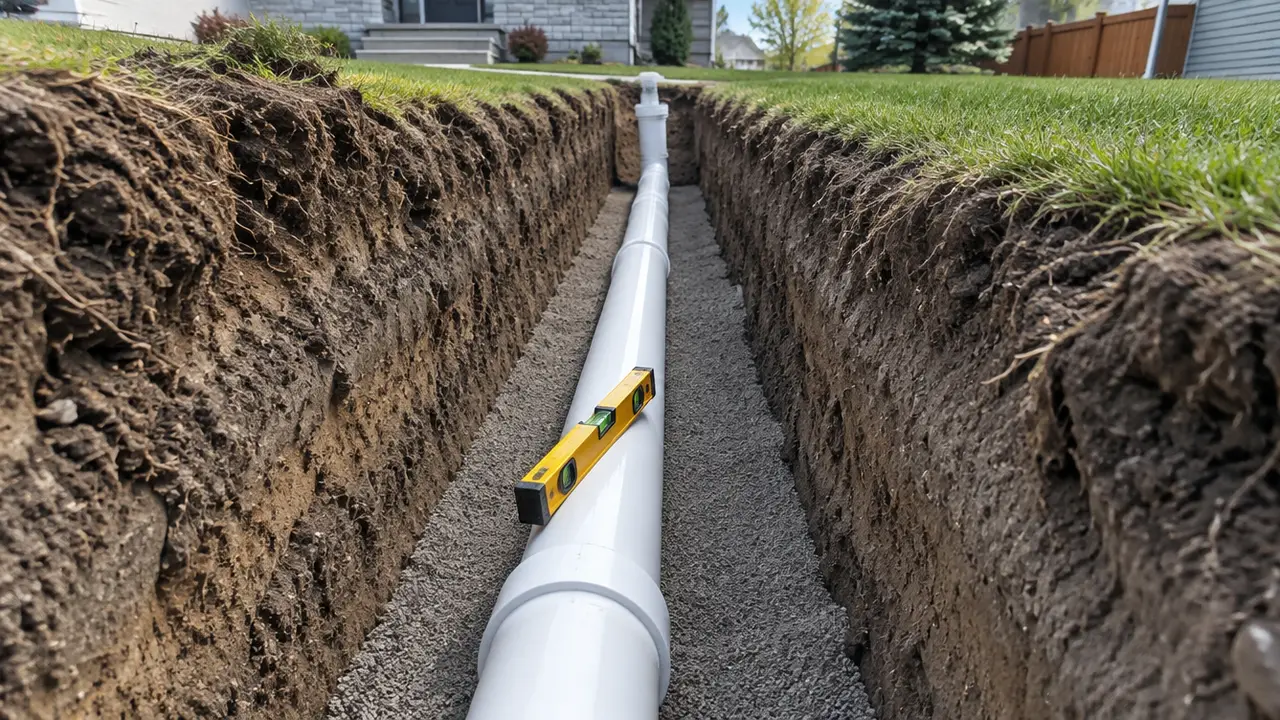
Slopes make trenches harder in three ways. Water runs down the trench, both while it is open and afterwards through the looser backfill, which can wash out bedding and carry fines away. Spoil piles on the uphill side load the trench wall. And machines work at an angle, with less margin for error near the edge. None of this changes the safety rule: in Alberta, walls deeper than 1.5 m must be cut back or supported before workers enter, and an engineer certifies protective structures for excavations deeper than 3 m.
- Keep surface water out of the open trench with berms or temporary diversion on the uphill side.
- Place bedding and backfill in compacted lifts; loose material on a slope settles and migrates.
- Ask the installer how water travelling along the backfilled trench will be managed, particularly where the trench points at a foundation.
- Plan restoration of the slope surface quickly, so rain does not scour the trench line before grass or cover establishes.
06 /Do steep sewers need more cleanouts?
They need cleanouts at every change of slope and wherever bends exceed the allowance, which on a hillside often means more than a flat lot. The spacing limits still apply: for 3 and 4-inch pipe, cleanouts no more than 15 m apart when they rod one way and 30 m when they rod both ways (NPC 2020 Table 2.4.7.2). Cleanouts that only allow rodding one way must point so the cable goes in the direction of flow. On a steep lot that matters, because pushing a cable uphill against a slope is harder and less effective.
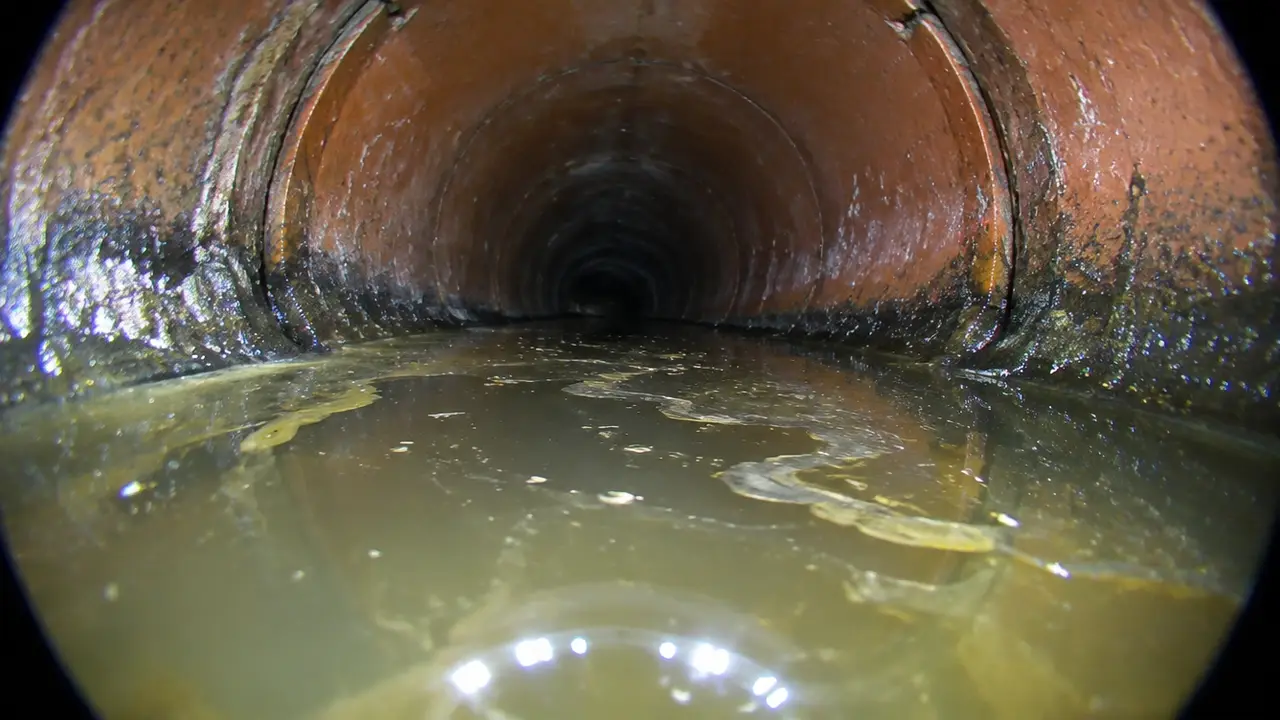
Each cleanout is also a future inspection point. On a line with several grade changes, a camera can be launched from the nearest cleanout rather than dragged the whole length. The detail of cleanout types, sizes and placement is in cleanout installation.
07 /What should a steep-lot quote show?
A profile, not just a plan. A proper steep-lot quote comes with a drawing of the ground line and the pipe line from the house to the connection, marked with the slope of each section, the cover at the shallowest point, the depth at the deepest point and every cleanout. It should say how trench walls will be supported, how water will be managed and how the slope will be restored. If an installer cannot produce that, ask why.
Planning ranges for each line item are in the installation cost guide. For a second opinion on a hillside design, send the profile and photos and the desk will reply with next steps.
FAQQuestions people ask
What is the maximum slope for a sewer line?
The National Plumbing Code of Canada sets no maximum. It sets minimums by pipe size, and its note says steeper slopes help keep pipes clean.
Can a sewer line change slope partway to the street?
On a building sewer, only at a cleanout. NPC 2.4.7.1(5) prohibits a change of slope between the building and the public sewer or between cleanouts.
How many bends can a sewer have between cleanouts?
For NPS 6 or smaller, fittings totalling no more than 45 degrees, or no more than 5 degrees every 3 m. Calgary allows two 22.5-degree or one 45-degree fitting foundation to street.
Is a steep sewer more likely to clog?
A steady steep grade is not. Clogs on steep lots usually form where a steep section meets a flat one, which is why grade changes go at cleanouts.
NETWORKGo deeper across the HAUSE Sewer network
Sewer inspection points and cleanouts: how to find, use or move one
What a sewer inspection point, chamber or cleanout is, how to find yours in a Canadian house, whether you can move or add one, and scoping through a toilet.
Where is my backwater valve? How to find it, recognize it and open the cover
Where is the backwater valve in a house? How to find it, what it looks like, what access box, sleeve and cover mean, how to open it safely, and valve alarms.
Snaking a drain from the roof vent: when it helps and when it does not
Can you snake a drain from the roof vent? When the vent stack is the right access, clearing a blocked or frost-closed vent, and the roof safety that comes first.