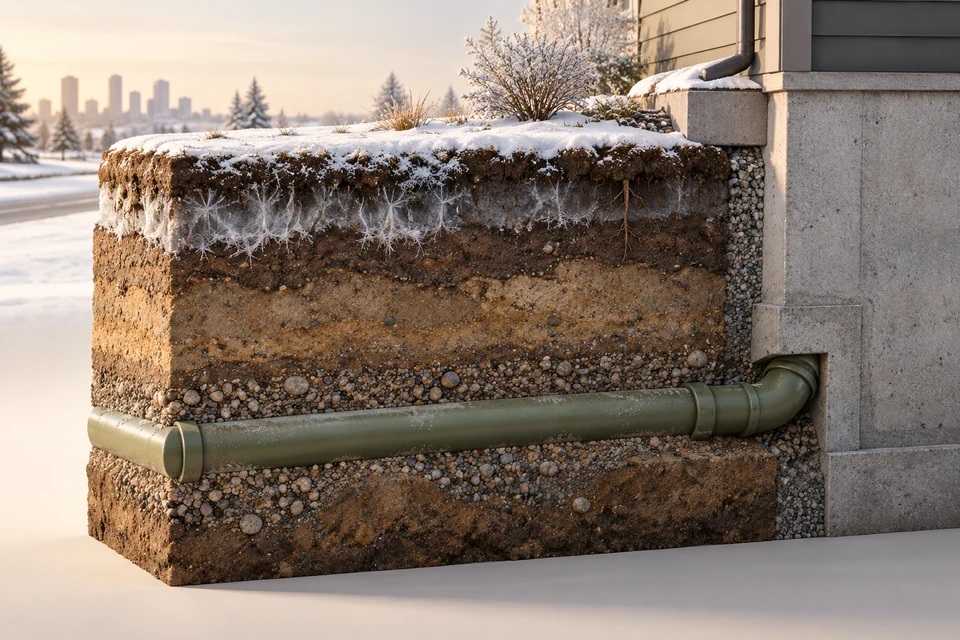
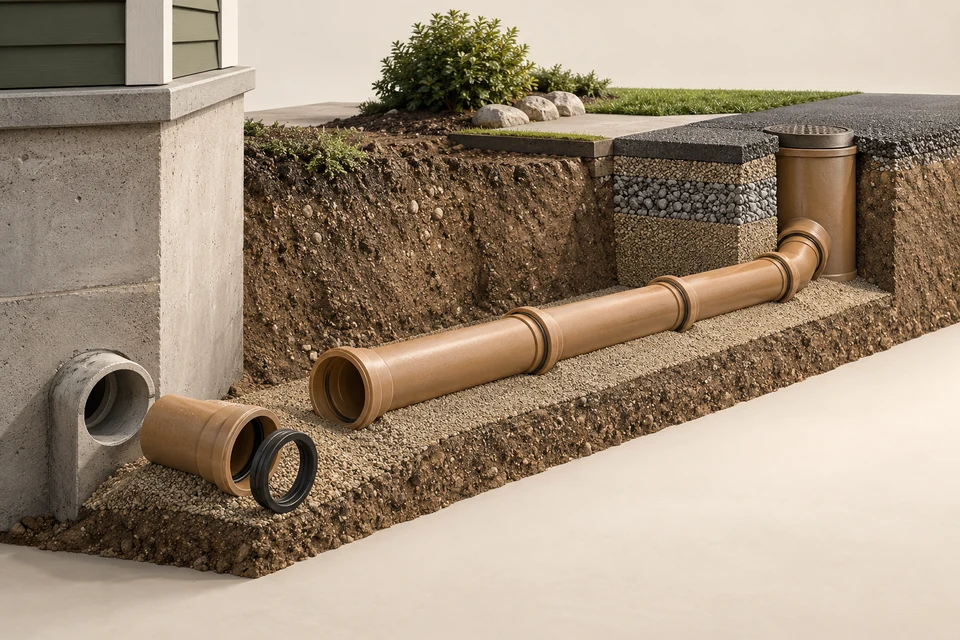
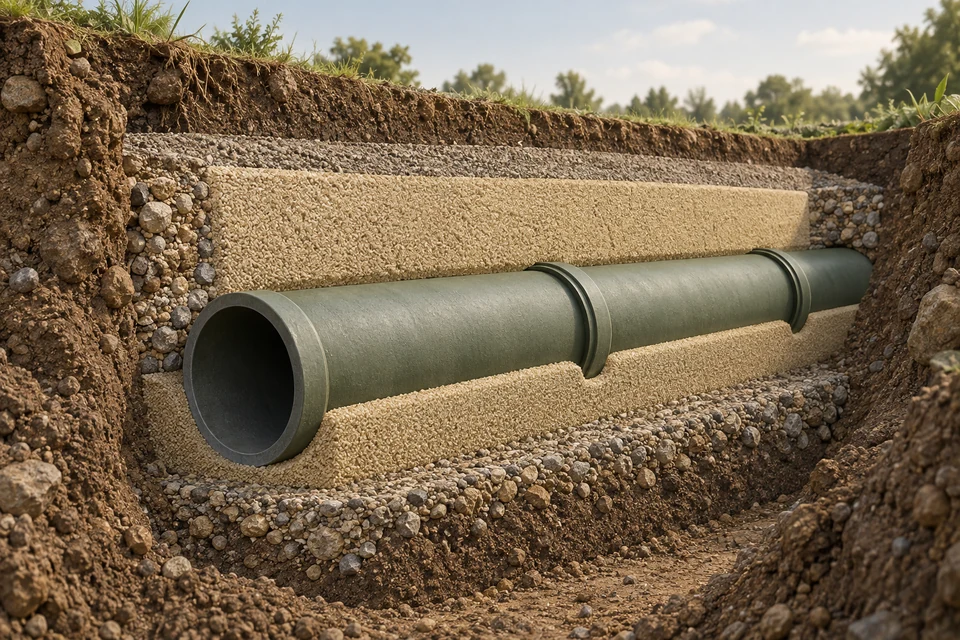
Enter the cover over the pipe at each end of the run, where the property is and what the trench carries. The planner compares your shallowest cover with the municipality's stated rule where one has been verified, such as Calgary's 4.5 ft for sanitary services, estimates the trench depth for Alberta's trench-safety threshold, and gives the earliest routine dig date after a locate request.
- Frost cover is a local rule, not a national number: the plumbing code only says pipe must be protected from freezing.
- Calgary states 4.5 ft (about 1.37 m) of cover for sanitary services and 8.5 ft (about 2.59 m) for water services.
- For Edmonton, the tool shows the EPCOR reference depth for new services and asks you to confirm the private-side rule.
- Trenches deeper than 1.5 m need cut-back or supported walls under Alberta's OHS Code before anyone enters.
Sewer Depth & Frost Cover Planner
01 /Why is frost cover a lookup rather than a formula?
Because the rule belongs to the municipality. The National Plumbing Code of Canada 2020, which Alberta enforces, says in Article 2.3.5.3 that piping which may be exposed to freezing must be protected from its effects. It does not give a depth, and it could not: frost penetration depends on climate, soil, snow cover and what is on the surface. So the minimum cover over a building sewer comes from the municipality that issues the permit. Some publish it; many answer it when asked.
This planner is built around that fact. It carries only the local numbers this site verified on official pages in September 2026. For anywhere else, it tells you who to ask rather than inventing a figure. That honesty is the point: a made-up frost depth that looks authoritative is worse than no number at all.
| Place | Rule used | Source |
|---|---|---|
| Calgary | 4.5 ft (about 1.37 m) of earth cover over sanitary sewer services; 8.5 ft (about 2.59 m) over water services | City of Calgary, Plumbing and gas for infill construction |
| Edmonton | Reference only: new sanitary service connections are set with the invert 2.75 m below finished grade at the property line | City of Edmonton / EPCOR Design and Construction Standards Vol. 3-03 (May 2025), 3.4.3 |
| Other Alberta municipalities and counties | No number; the national code requires protection from freezing | NPC 2020 2.3.5.3; ask the permit issuer |
| Outside Alberta | No number | Ask the local authority |
02 /What do you enter?
Seven inputs, all visible above. Cover here means the depth from finished grade down to the top of the pipe, not to its bottom. If you know invert depths instead, subtract the pipe's outside size to get cover.
- Where the property is: Calgary, Edmonton, another Alberta municipality or county, or outside Alberta.
- What goes in the trench: a sanitary building sewer, the sewer and water service together, or a water service only.
- Cover at the house and cover at the far end, in metres. The shallowest of the two is what gets compared with the rule, because on a straight graded pipe the shallowest point is at one end.
- Pipe size: 4 or 6 inch, used only in the trench-depth estimate.
- What is on top of the line: lawn or garden that keeps its snow, some driveway or walkway, or mostly paving kept clear of snow.
- The day you will request locates, which defaults to today.
03 /How does it judge the cover in Calgary?
For a sanitary sewer, it compares your shallowest cover with 4.5 ft, converted at 0.3048 m per foot to 1.37 m. If the cover is at least that, the verdict is "Cover meets the Calgary minimum"; if not, "Too shallow for the Calgary minimum", with the shortfall in millimetres. For a water service only, it compares with 8.5 ft, or 2.59 m.
When you choose sewer and water together, it still judges the sewer against 4.5 ft, then adds a row explaining that the water service needs its own 2.59 m of cover, so the water line sets the depth of the trench. The trench-depth estimate then uses the water cover plus an allowance for the pipe and bedding.
If the cover falls short, the planner suggests the ways out: lower the pipe and recheck the fall with the Sewer Slope & Fall Calculator, move the route away from cleared surfaces, or ask the permit office what it will accept where full cover is impossible. It deliberately does not suggest a thickness of insulation board, because an approved alternative is the authority's decision, and it tells you to get that answer in writing.
04 /What happens for Edmonton and everywhere else?
For Edmonton, the planner shows your shallowest cover next to the reference depth from the EPCOR drainage design standard (section 3.4.3, May 2025): new sanitary service connections are set with the invert 2.75 m below finished grade at the property line. That governs how new services are designed; it is not a statement of the minimum cover on the private side of an existing lot. So the verdict is "Look up the private-side rule", and the note asks you to confirm with the City's plumbing permit office or EPCOR.
For any other Alberta municipality or county, the verdict is "Confirm the cover with your permit issuer". The note explains that the national code requires protection from freezing without a depth, and points to the Safety Codes Council's accredited-organization search, which identifies the municipality or agency that issues permits for any address. Outside Alberta, the planner simply says to ask the local authority. In every case it still reports your shallowest cover so you have the number ready when you ask.
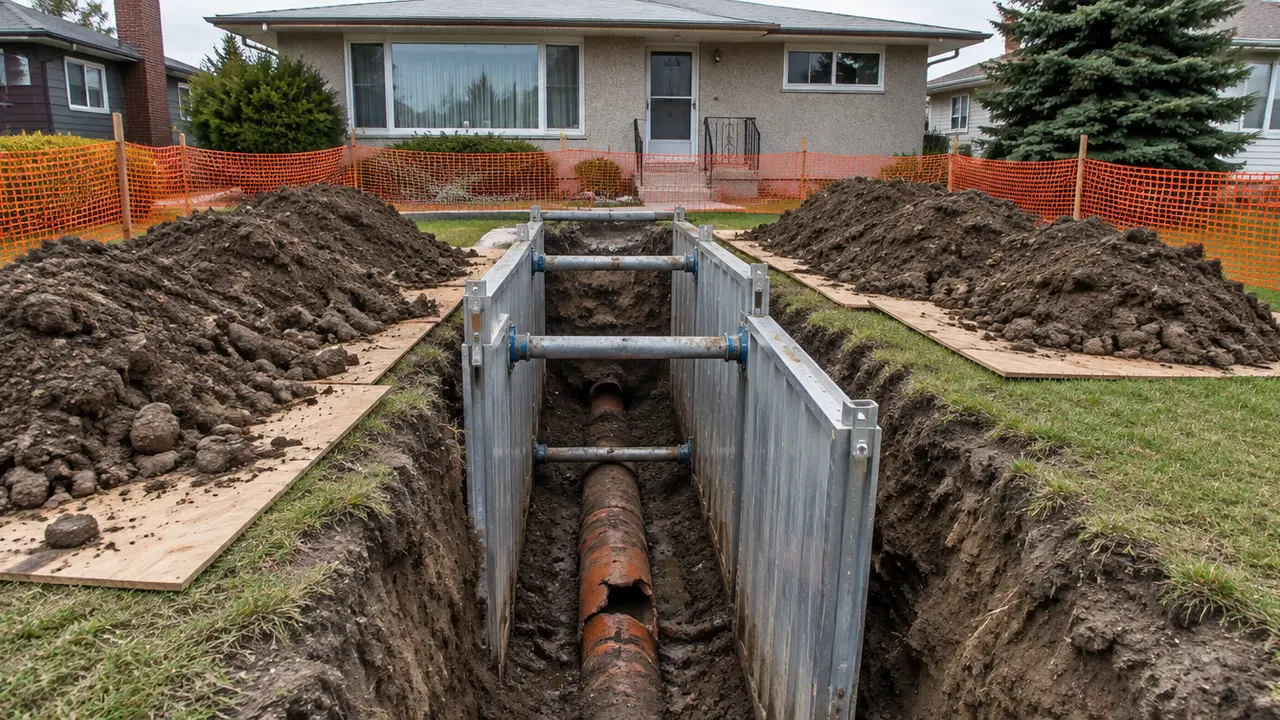
05 /Why does the surface over the line matter?
Snow is insulation. A lawn that keeps its snow all winter shelters the ground; a driveway or walkway shovelled bare loses heat to the air, and frost usually goes deeper beneath it. When you choose "some driveway or walkway" or "mostly paving kept clear of snow", the planner adds a note that a municipal minimum is a floor, not a target, and that it is worth asking about extra depth where the line runs under cleared paving. It does not put a number on the extra, because that depends on the site.
06 /How are the trench depth and safety flag worked out?
The planner takes the deeper of your two cover figures, adds the pipe size and 100 mm of bedding, and reports that as an approximate trench depth at the deep end. With sewer and water together in Calgary, it uses the water service cover instead. If the estimate exceeds 1.5 m, it flags the trench as over 1.5 m and adds a note: Alberta's OHS Code Part 32 requires trench walls deeper than 1.5 m to be cut back or supported by a temporary protective structure before workers go in. Over 3 m, it adds that a protective structure for an excavation that deep must be designed and certified by a professional engineer. Outside Alberta, it notes that your province's rules apply.
Most house sewers in the Calgary region end up deeper than 1.5 m at one end, so this flag is normal, not alarming. Its purpose is to make sure shoring or a trench box is in the plan and the price. The approximation ignores wall thickness and over-excavation, which is why it is labelled approximate.
07 /How is the earliest dig date calculated?
Utility Safety Partners, Alberta's one-call locate service, asks for a minimum of three full working days' notice for a routine request. The planner counts forward from the day you request locates, skipping Saturdays and Sundays, and gives the fourth working day as the earliest dig date. A request on Thursday, September 24, 2026 gives Wednesday, September 30. Statutory holidays are not skipped, so add a day when one falls in the window.
Two cautions travel with that date. When checked in September 2026, the service's site warned that response times might be five to ten business days because of volume, and it states that you are not clear to dig until every utility has been located. Member utilities mark their own lines; private lines such as an old sewer or a feed to a garage usually need a private locator. The steps around locating are in the installation process.
08 /What can this planner not tell you?
It cannot measure frost, soil or groundwater on your lot. It does not know any municipal rule beyond the ones listed above, and rules change. It does not design insulation, and it does not replace the permit office's answer. Its trench estimate is a rough allowance, not a shoring design. Use it to arrive at the permit office and the contractor meeting with the right questions: what cover do you require here, how deep is my connection, and how will the trench be supported? The long-form background is in how deep is a sewer line?, and the local detail for each community around Calgary is on the service areas page.
FAQQuestions people ask
What is frost cover for a sewer line?
The depth of earth over the top of the pipe, set so the pipe stays below the depth where the ground freezes. Calgary states 4.5 ft for sanitary services.
Why does the planner not give a frost depth for my town?
Because it only carries figures verified on official pages. The plumbing code sets no depth, so each municipality decides; ask your permit issuer.
Is the Calgary water service cover really deeper than the sewer?
Yes. The City states 8.5 ft for water services against 4.5 ft for sanitary sewer services, so a shared trench is dug to suit the water line.
Does the dig date include holidays?
No. It skips weekends only. Add a day for any statutory holiday in the window, and allow for the longer response times the locate service has warned about.
Can I use insulation instead of depth?
Only if the permit office approves it for your site. The planner does not assume foam board is an accepted substitute.
NETWORKGo deeper across the HAUSE Sewer network
Sewer line replacement cost by city: why local quotes differ
Sewer line replacement cost by city: why Calgary, Edmonton, Regina and other Canadian markets quote differently, GST/HST by province, and local drivers.
Hydro jetting weeping tile: how foundation drains are cleaned, and when they cannot be
Hydro jetting weeping tile explained: how foundation drains clog with silt, roots and iron ochre, how they are jetted from the sump, and when to replace them.
Sewer scope inspections in Edmonton: what to expect and who to call
Sewer scope and sewer line inspection in Edmonton: what mature and newer neighbourhoods show on camera, cold and clay soils, elms, EPCOR and 311 checks.
SOURCESSources and further reading
- City of Calgary: Plumbing and gas for infill construction
- EPCOR / City of Edmonton: Design and Construction Standards Volume 3-03, Design Guidelines (May 2025)
- Utility Safety Partners: Submit a locate request
- Alberta OHS Code Part 32: Excavating and tunnelling
- Safety Codes Council: Where to get a permit